


Sorry, no sales person is available right now to take your call. Pls leave a message and we will reply to you via email as soon as possible.
How to Choose Ceramic Substrates for Power Semiconductors? A Guide to the Material Logic Behind DBC/AMB Substrates
2026-09-02
As new energy, energy storage, and on-board power devices continue to evolve toward higher currents and greater power density, the ceramic substrate—acting as the "thermal backbone" of the power module—directly determines the device's heat dissipation capability and long-term reliability. Different ceramic materials vary significantly in thermal conductivity, dielectric properties, and coefficient of thermal expansion (CTE). This article systematically reviews the performance characteristics, application scenarios, and key selection criteria for mainstream ceramic substrates, offering practical reference for engineering teams choosing DBC and AMB substrates.
Power semiconductors are core components in new energy vehicles, photovoltaic storage, industrial power supplies, and high-speed laser equipment. As power density continues to rise, heat generated by chips—if not dissipated promptly—can directly lead to excessive junction temperatures, thermal-cycle cracking, and even premature device failure. Ceramic substrates serve three essential functions—insulation, heat conduction, and circuit routing—making them the critical bridge between the chip and the heat-sink housing. Currently available ceramic materials such as diamond, aluminum nitride, silicon nitride, alumina, and boron nitride span a vast performance range, and many hardware engineers tend to fall into the trap of "thermal-conductivity-only" thinking.
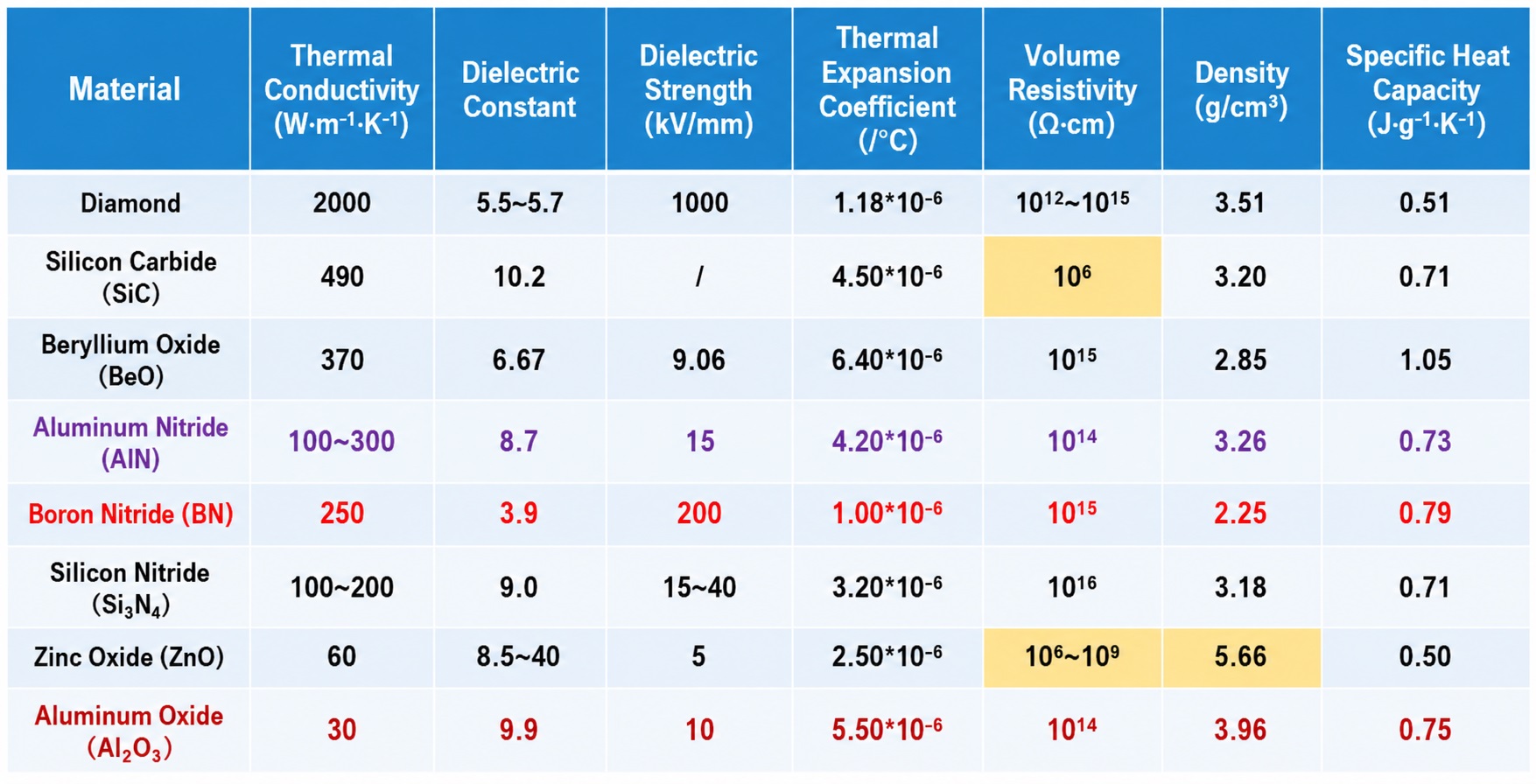
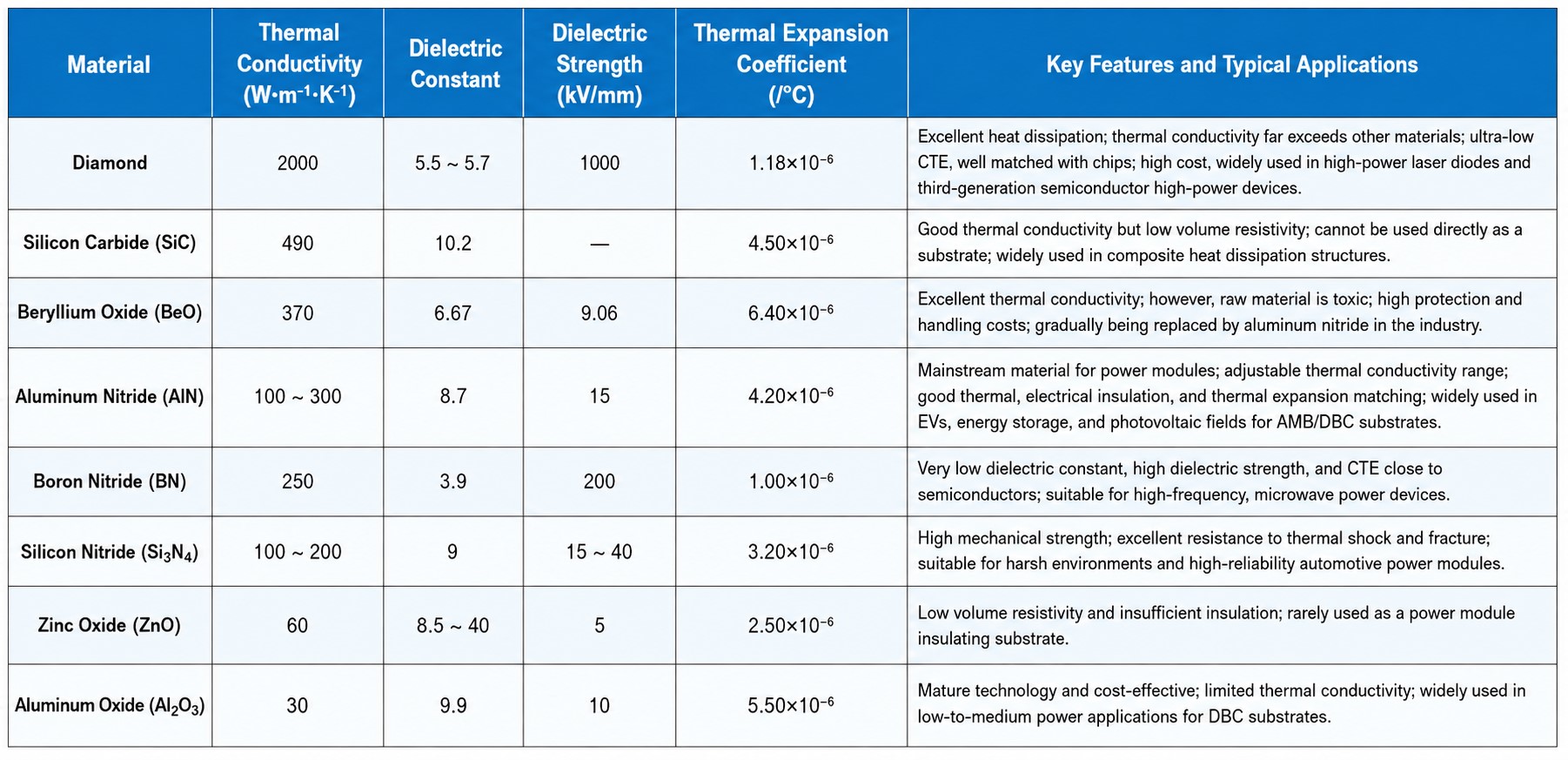
Core Performance Comparison of Mainstream Ceramic Substrates


Key Points for Engineering Selection
1. Thermal Dissipation Hierarchy
Diamond leads by a wide margin in thermal conductivity, followed by silicon carbide and beryllium oxide. In large-scale industrial production, aluminum nitride (AlN) remains the mainstream choice for balancing performance and cost. Alumina has the lowest thermal conductivity and is preferred for low-to-medium power applications.
It is worth noting that the performance of the same material is not fixed. For example, standard-grade AlN offers thermal conductivity around 120–180 W/m·K, while high-purity grades can reach 260–300 W/m·K. When selecting, be sure to confirm the specific grade parameters with the substrate supplier.
2. CTE Matching – The Key to Module Lifespan
Power modules undergo numerous thermal cycles during repeated on-off operation. If the CTE of the ceramic substrate differs too much from that of SiC or Si chips, micro-cracks tend to initiate at the metal-ceramic interface, eventually leading to delamination failure.
· Boron nitride and silicon nitride have lower CTE values, offering good matching with chips and excellent thermal-cycle resistance.
· Alumina has a relatively high CTE, and under high-power, frequent thermal-shock conditions, its risk of failure increases significantly.
3. Dielectric Properties – Distinguishing Power vs. High-Frequency Applications
· Boron nitride (BN) has a dielectric constant of only 3.9, with low high-frequency losses, giving it a clear advantage in RF/microwave applications.
· Alumina, aluminum nitride, and silicon nitride have dielectric constants in the range of 8.7–9.9, making them more suitable for high-voltage insulation requirements in power electronics modules.
4. Critical Warnings
· Silicon carbide (SiC) and zinc oxide (ZnO) have insufficient intrinsic insulation and cannot be used directly as insulating substrates—they require composite insulating layers.
· Beryllium oxide (BeO) dust is toxic; grinding and cutting processes must be equipped with full enclosed protective measures. New projects should prioritize alternative materials.
· Do not focus solely on thermal conductivity. Long-term reliability is a comprehensive trade-off involving thermal conductivity, insulation performance, CTE matching, mechanical strength, manufacturing cost, and process feasibility.
Selection Recommendations by Application Scenario
· On-board power modules and energy-storage converters: Prioritize aluminum nitride (AlN). If operating conditions involve severe shocks and extremely stringent reliability requirements, silicon nitride (Si₃N₄) substrates may be considered.
· RF/microwave high-frequency devices: Prioritize boron nitride (BN).
· Low-to-medium power supplies and general industrial modules: Choose alumina (Al₂O₃) for cost-effectiveness.
· Ultra-high-power lasers and advanced third-generation semiconductor devices: Evaluate diamond substrates (with careful cost assessment for cost-sensitive projects).
The selection of ceramic substrates is by no means "higher parameters are always better." Many engineers tend to use thermal conductivity as the primary or even sole criterion, often overlooking equally critical factors such as CTE matching, mechanical strength, manufacturing feasibility, and overall cost. In practice, a multi-dimensional evaluation—considering chip type, operating power, thermal cycling conditions, and budget constraints—should guide the final choice of ceramic material for DBC or AMB substrates, achieving the best balance of performance, reliability, and economy.
Final Note
In real-world implementation, theoretical material properties do not always translate into actual product performance. The bonding process between ceramic and metal, as well as manufacturing yield, directly affect the final reliability of the module. Kinji Group offers DBC and AMB substrate manufacturing and supporting PCB processing services across alumina, aluminum nitride, and silicon nitride material systems, with DFM pre-evaluation for demanding applications in automotive, energy storage, and laser sectors. For sample prototyping or volume production needs, please contact our technical team for selection guidance and quotations.
trending news
Contact Us