


Sorry, no sales person is available right now to take your call. Pls leave a message and we will reply to you via email as soon as possible.
Kinji Aluminum Nitride Ceramic Substrate: Solving the Heat Dissipation Challenge of High-Power Devices, Empowering High-End Applications Across All Scenarios
2026-08-07
High-power LEDs, lasers, automotive lighting, and industrial lighting are all facing common bottlenecks: excessive junction temperature, severe light attenuation, insufficient reliability, and persistently high failure rates. Traditional aluminum-based and alumina substrates can no longer meet the stringent requirements of automotive, industrial, and laser-grade applications.
The Kinji Aluminum Nitride (AlN) Ceramic Substrate, with its four core capabilities—high thermal conductivity, high insulation, high thermal stability, and high adaptability—provides a one-stop heat dissipation solution for high-end devices, from chip to system. It has achieved mass deployment in three core scenarios: automotive headlights, high-power lasers, and industrial lighting, leveraging full-chain technical strength to solve industry pain points.

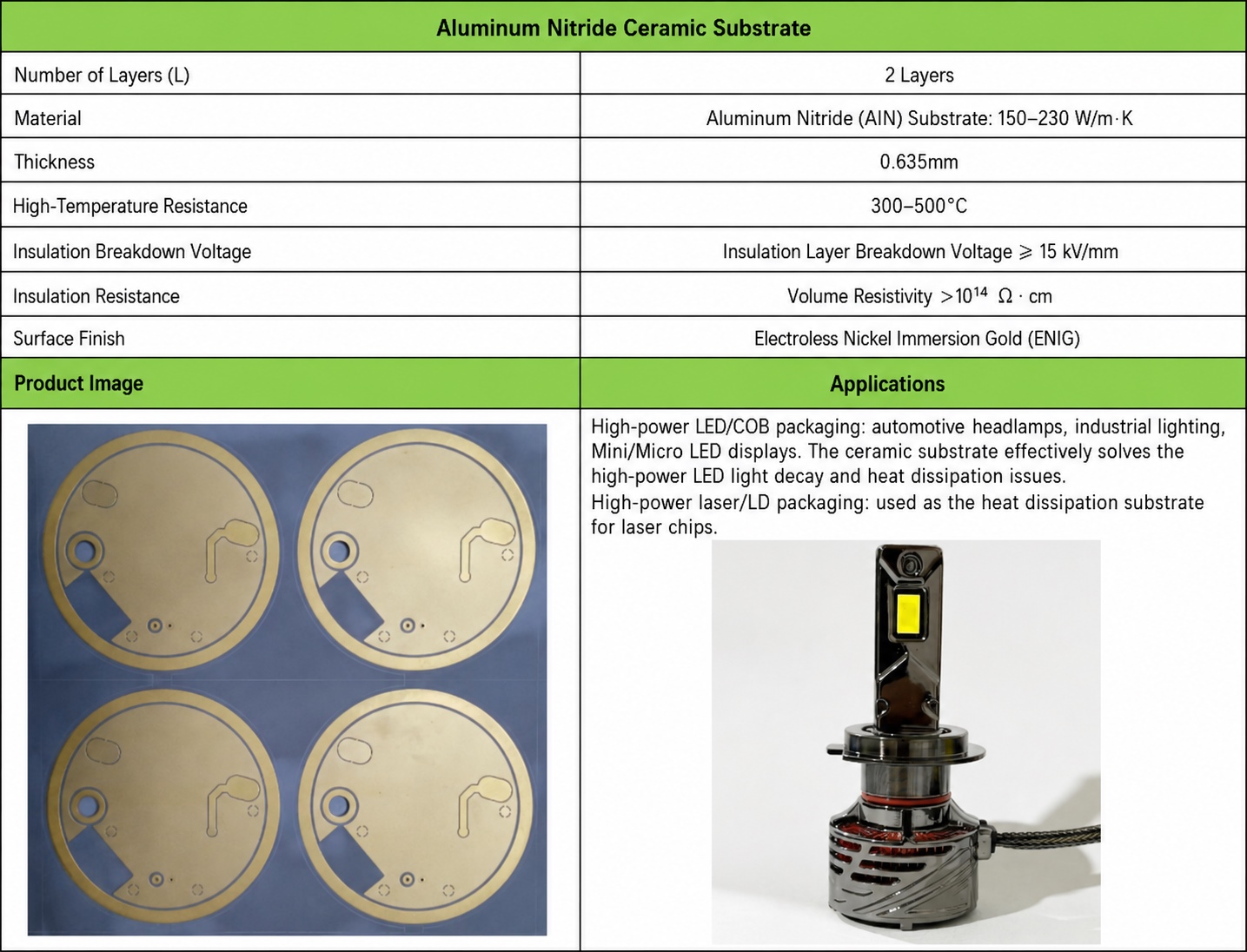
Core Hardcore Parameters, Building a Foundation of Performance
This aluminum nitride ceramic substrate is crafted with extreme processes for every specification, demonstrating its "industry benchmark" hardcore strength with data:
Kinji Core Technical Capabilities
Kinji possesses full-chain technical capabilities, from material selection, ceramic substrate manufacturing, multi-layer circuit design, metallization processes to reliability verification:
· Proprietary aluminum nitride ceramic tape casting and sintering processes, with stable thermal conductivity controlled at 150–230 W/m·K.
· Precision double-layer wiring technology, with high line width/line spacing accuracy, suitable for high-density packaging.
· Ultra-thin substrate manufacturing, standard thickness 0.635mm, balancing strength and heat dissipation.
· Electroless Nickel Electroless Palladium Immersion Gold (ENEPIG) surface finish, offering strong adhesion, reliable soldering, oxidation resistance, and corrosion resistance.
· Wide temperature tolerance: 300–500°C, insulation voltage resistance ≥15 kV/mm, volume resistivity >10¹⁴ Ω·cm.
· Automotive-grade quality control system: capable of providing complete verification including thermal shock, high-temperature aging, salt spray, and vibration tests.

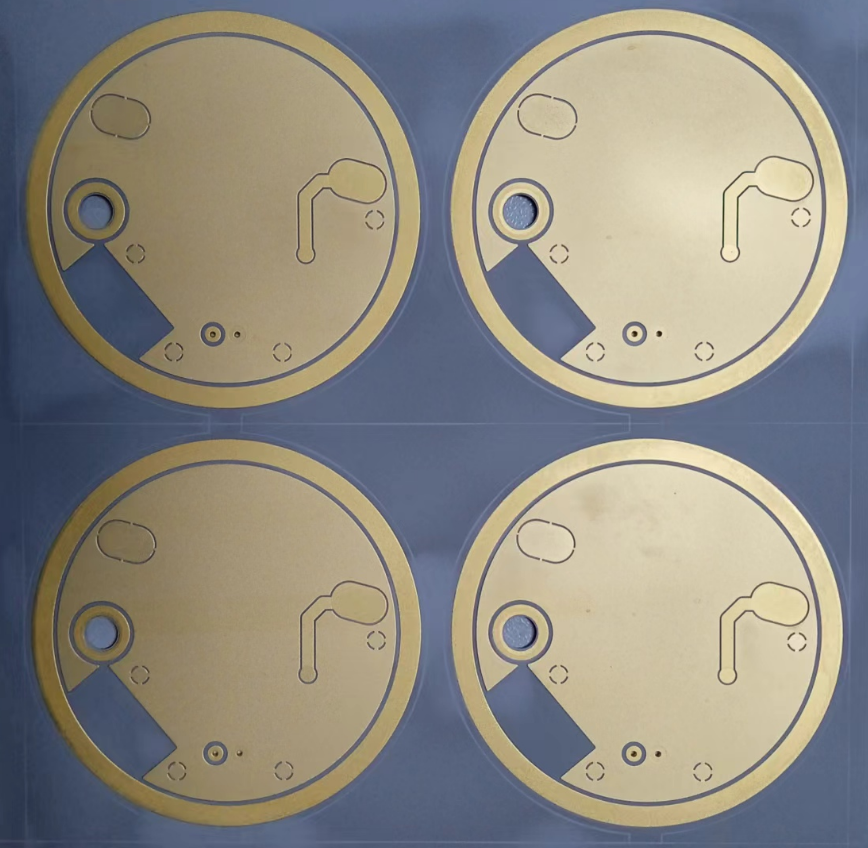
Kinji 2-Layer Aluminum Nitride Ceramic Substrate
Full-Scenario Industry Applications, Empowering Industrial Upgrades with Strength
(I) Automotive Headlights/Laser Headlights: Solving Light Attenuation, Building Automotive-Grade Reliability
As the power of matrix headlights and laser headlights continues to increase, junction temperature control and long-term reliability become critical. Traditional aluminum substrates often suffer from significant light attenuation, short lifespan, and poor adaptability to the engine compartment environment.
Leveraging its ultra-high thermal conductivity, the Kinji Aluminum Nitride Substrate can rapidly dissipate heat from the chip, effectively reducing the core junction temperature by 15–25°C, fundamentally suppressing light attenuation. It also possesses excellent high-temperature resistance, vibration resistance, and salt spray resistance, fully meeting the stringent requirements of automotive-grade environments, ensuring stable operation for automotive headlights.
Actual Case:
In a high-end matrix headlight project for a leading domestic automotive lighting company, this substrate was used for their 2025 premium SUV matrix headlights (single lamp power 35W, continuous daily illumination over 16 hours, supporting major passenger car OEMs). The actual application results were significant:
· Original Aluminum Substrate: After 100 hours of continuous illumination, junction temperature >115°C, light attenuation 8.2%.
· Kinji AlN Substrate: Under the same conditions, junction temperature dropped to 92°C, light attenuation only 2.1%.
The substrate passed a 2000-hour salt spray test (meeting GB/T 10125-2021 standards) and 1000 cycles of thermal shock testing (-40°C~85°C, meeting IATF 16949 automotive requirements), perfectly adapting to the complex engine compartment environment. Product lifespan increased by more than 3 times and is currently mass-supplied for various passenger car models and off-road modified headlights.
(II) Industrial Lighting: Adapting to Extreme Conditions, Achieving Long-Term Stable Operation
Scenarios like industrial mining lights, explosion-proof lights, port floodlights, and blast furnace lighting face high temperatures, high humidity, high corrosion, and strong vibrations. Ordinary substrates are prone to aging, insulation failure, and frequent damage.
The Kinji Aluminum Nitride Substrate features an organic-free composition design, offering core advantages of no oxidation, no cracking, and corrosion resistance. It maintains stable performance in extreme industrial environments, significantly reducing equipment failure rates and greatly extending the service life of lighting equipment, fully meeting the demanding requirements of various industrial lighting scenarios.
Actual Case:
In a lighting retrofit project for the blast furnace area of a major steel group (a Top 3 domestic steel enterprise), this substrate was used for illumination 10 meters from the blast furnace mouth (ambient temperature 65°C, dust concentration 150mg/m³), effectively solving the pain point of frequent traditional substrate failures:
· Original Aluminum Substrate: Substrate-related faults occurred every 3 months, resulting in extremely poor equipment stability.
Kinji AlN Substrate: No substrate-related faults for 18 consecutive months. Verified by high-temperature aging tests (meeting GB/T 2423.2-2008 standards), the overall equipment lifespan increased by more than 6 times.
· Beyond blast furnace lighting, this substrate also performed exceptionally well in a port high-mast floodlight project:
In the port high-mast floodlight project, facing harsh conditions of high salt spray and strong vibration, the substrate passed salt spray tests (meeting GB/T 10125-2021 standards) and vibration tests (meeting GB/T 2423.10-2019 standards), achieving zero substrate faults over 3 years, significantly enhancing lighting stability and safety.
(III) High-Power Lasers/Laser Diodes: Stable Heat Dissipation Guarantees, Improving Output Yield and Accuracy
High-power lasers and laser diodes (LD) have extremely high heat flux densities. Insufficient heat dissipation from traditional substrates can easily lead to power drift, degraded beam quality, low yield, and chip damage.
The Kinji Aluminum Nitride Substrate has a thermal expansion coefficient that closely matches semiconductor chips, effectively reducing thermal stress damage and preventing chip delamination or cracking. Its ultra-high thermal conductivity quickly dissipates heat, ensuring long-term stable laser output and helping to improve product yield and operational precision.
Actual Case:
In a 1000W continuous fiber laser project for a leading industrial laser company, this substrate was used for precision metal cutting applications (laser output wavelength 1070nm, continuous daily operation over 16 hours). The advantages over traditional substrates were significant:
· Original Alumina Substrate: Significant power fluctuation after 24 hours, cutting yield of 92%.
· Kinji AlN Substrate: Stable high-power output for 72 continuous hours, power fluctuation <±0.5% (meeting ISO 11146 standards), yield reaching 99.8% (tested per GB/T 30582-2014 standards).
· Furthermore, this substrate has also demonstrated outstanding performance in medical lasers and automotive LiDAR: When used in dermatology therapeutic lasers (output power 50W), the output precision error is <0.3% (meeting YY/T 0285.1-2017 standards); when applied to automotive LiDAR, heat dissipation efficiency increased by 30%, and detection stability improved by 25% (meeting ISO 26262 automotive standards), fully adapting to the stringent requirements of multiple scenarios.
Kinji Core Advantages — More Than Just Quality Substrates, Providing Full-Scenario Solutions
· Full-Process Self-Developed and Controlled: One-stop proprietary manufacturing processes for ceramic tape casting, metallization, etching, electroplating, and testing.
· High-Precision Double-Layer Circuits: Meeting the packaging needs of high-density, small-size, and high-power devices.
· Automotive-Grade Quality: Supporting IATF 16949 system requirements and mass delivery capabilities.
· Rapid Customization Capability: Flexible customization for dimensions, wiring, thickness, and surface finishes.
· Real-World Scenario Validation: Proven in mass, stable operation across industries including automotive lighting, steel, ports, and lasers.

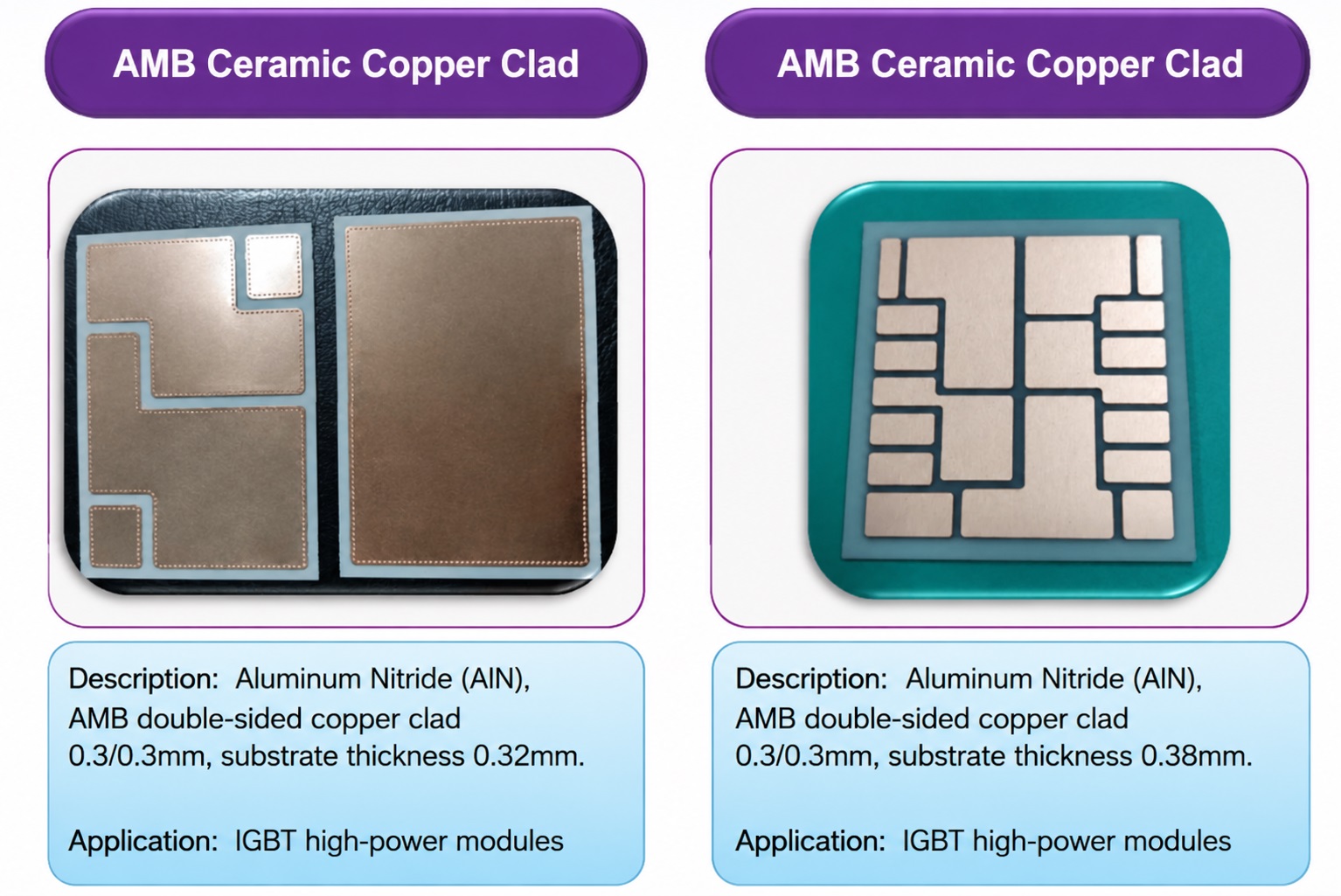
Kinji Selected Silicon Nitride and Aluminum Nitride Ceramic Substrate Products
As high-power devices continue to advance, heat dissipation capability has become the core element determining product competitiveness and is key for companies to achieve product iteration and seize market opportunities.
The Kinji Aluminum Nitride Ceramic Substrate, backed by full-chain proprietary technical capabilities in materials, processes, design, and validation, provides truly reliable high-end heat dissipation solutions for diverse fields such as automotive, industrial lighting, and high-power lasers. It comprehensively addresses industry pain points like junction temperature, light attenuation, and reliability, making devices more stable, extending lifespan, and enhancing system safety.
Kinji — A professional provider of high-end ceramic substrates, driven by technological innovation. We partner with industry leaders to co-define the next-generation heat dissipation standards for high-power devices.
trending news
Contact Us