

Sorry, no sales person is available right now to take your call. Pls leave a message and we will reply to you via email as soon as possible.
HDI Board Material Selection Guide (Core Essentials + Selection Comparison Table + Practical Cases)
2026-08-03
HDI (High-Density Interconnect) boards, leveraging their advantages of high-density routing through micro-vias, fine lines, and narrow pitch, are widely used in consumer electronics, communication equipment, automotive electronics, industrial control, aerospace, and other sectors. Material selection is a critical link in the design and volume production of HDI boards, directly impacting signal transmission performance, thermal stability, mechanical reliability, environmental adaptability, and manufacturing costs. Practical selection requires comprehensive judgment based on circuit design specifications, operating conditions, processing technologies, and project budgets. This article systematically outlines the core basis for HDI board material selection, supplemented by practical cases, a quick selection table, and a detailed parameter comparison table, forming a implementable material selection specification.
I. Core Considerations for HDI Board Material Selection (with Application Cases)
1. Electrical Performance: Ensuring High-Speed Signal Integrity
Electrical performance is the primary indicator for high-speed HDI board selection, directly determining signal transmission quality and system stability. Three key parameters warrant close attention:
· Characteristic Impedance: Requires matching of substrate and copper foil to precisely control impedance values and avoid signal reflection and attenuation.
· Insulation Resistance: High-insulation substrates should be selected to reduce leakage current and crosstalk.
· Dielectric Constant (Dk) and Dissipation Factor (Df): For high-frequency and RF circuits, low-Dk and low-Df substrates are preferred to suppress signal delay and distortion.
· Case Study: For mid-to-low frequency products such as standard smartphone sub-boards and digital peripherals, FR-4 suffices for impedance and insulation requirements. For 5G millimeter-wave RF modules and high-speed communication HDI boards, which are extremely sensitive to signal loss, the industry commonly uses low-loss BT substrates to effectively reduce high-frequency attenuation and ensure communication speed and stability.
2. Thermal Performance: Adapting to Complex Temperature Conditions
Circuit boards generate continuous heat during operation, and some equipment must endure prolonged high temperatures or thermal cycling. Thermal performance metrics include:
· Thermal Conductivity: High-power HDI boards require substrates with high thermal conductivity for rapid heat dissipation to prevent component overheating.
· Coefficient of Thermal Expansion (CTE): Substrates with CTE matching that of chips and components should be prioritized to minimize thermal stress and prevent delamination, broken traces, and solder joint failure.
· Case Study: Automotive center-console HDI boards operate under prolonged -40°C to 85°C thermal cycling. Standard FR-4, due to poor CTE matching, is prone to delamination and solder joint failure; BT substrates are the industry mainstream for this application. Automotive BMS (battery management system) boards, subject to severe high-temperature loads, exclusively use PI substrates for their extreme heat resistance to avoid failure.
3. Mechanical Properties: Enhancing Structural Reliability
With dense routing and precision construction, HDI boards demand higher mechanical performance from substrates. Considerations include:
· Mechanical Strength and Toughness: To withstand process stresses from drilling, lamination, and etching, as well as vibration, bending, and compression during use.
· Warpage Resistance: For applications requiring high flatness, such as industrial equipment and outdoor terminals, glass-fiber-reinforced substrates are preferred.
· Case Study: Flexible wearable devices like smartwatches and wristbands, subject to repeated bending, require high-toughness PI substrates to prevent trace fractures. Industrial fixed-mount control boards, subject only to routine vibration, can use glass-fiber-reinforced FR-4, balancing performance with cost control.
4. Dimensional Accuracy: Meeting High-Density Routing Requirements
Characterized by micro-vias, fine lines, and narrow pitch, HDI boards impose stringent demands on dimensional stability. Substrates with low shrinkage and high stability should be selected to prevent expansion or contraction deformation during processing and temperature changes, ensuring precision structures meet tolerances and improving yield.
Case Study: High-end smartphone camera modules and precision sensor modules, featuring extremely fine pitch and dense micro-vias, require low-shrinkage BT substrates to effectively suppress deformation. Low-end digital products with lower routing density can be satisfied with FR-4.
5. Processability: Enabling Volume Production and Cost Reduction
Substrate processability directly affects yield and cost. Excellent processability manifests as smooth drilling, etching, lamination, and assembly, reducing defects such as plugged vias, misregistration, delamination, and blistering. Selecting substrates with mature processes and strong compatibility reduces processing difficulty, improves efficiency, and minimizes waste.
Case Study: High-volume products such as smart home devices and consumer electronics uniformly adopt FR-4, leveraging mature processes for high yield and low cost. For military-customized and high-end precision prototypes in small batches, where higher costs are acceptable, BT and PI substrates are preferred to guarantee precision and reliability.
6. Environmental Reliability: Matching End-Use Scenarios
Preference should be given to standardized substrates with proven performance through industry-wide volume verification. Selection varies by environment:
· Standard Indoor Ambient Temperature: General-purpose substrates.
· Harsh Conditions (High Temperature, High Humidity, Salt Fog, Corrosion, High Vibration): Specialty substrates with weather resistance, corrosion resistance, and aging resistance should be selected.
· Case Study: Outdoor base stations and surveillance equipment, long exposed to high humidity and salt fog, require BT substrates as FR-4 lacks sufficient weather resistance. Marine monitoring and chemical explosion-proof equipment, operating in severely corrosive environments, must use PI substrates.
7. Cost Control: Balancing Performance and Budget
Costs vary significantly among different substrates. The principle of "performance meets requirements, optimal cost-effectiveness" should be followed to avoid over-specification, achieving the best balance between performance and cost.
Case Study: Cost-sensitive products such as entry-level smart home devices and digital accessories uniformly adopt FR-4. High-end flagship consumer electronics and military specialty equipment prioritize reliability and choose BT or PI based on operating conditions.
II. Mainstream HDI Substrate Characteristics and Industry Applications
Currently, the mainstream HDI substrates in volume production are FR-4, PI (Polyimide), and BT, with distinct performance positioning and clearly defined application scenarios.
1. FR-4: General-Purpose Base Substrate
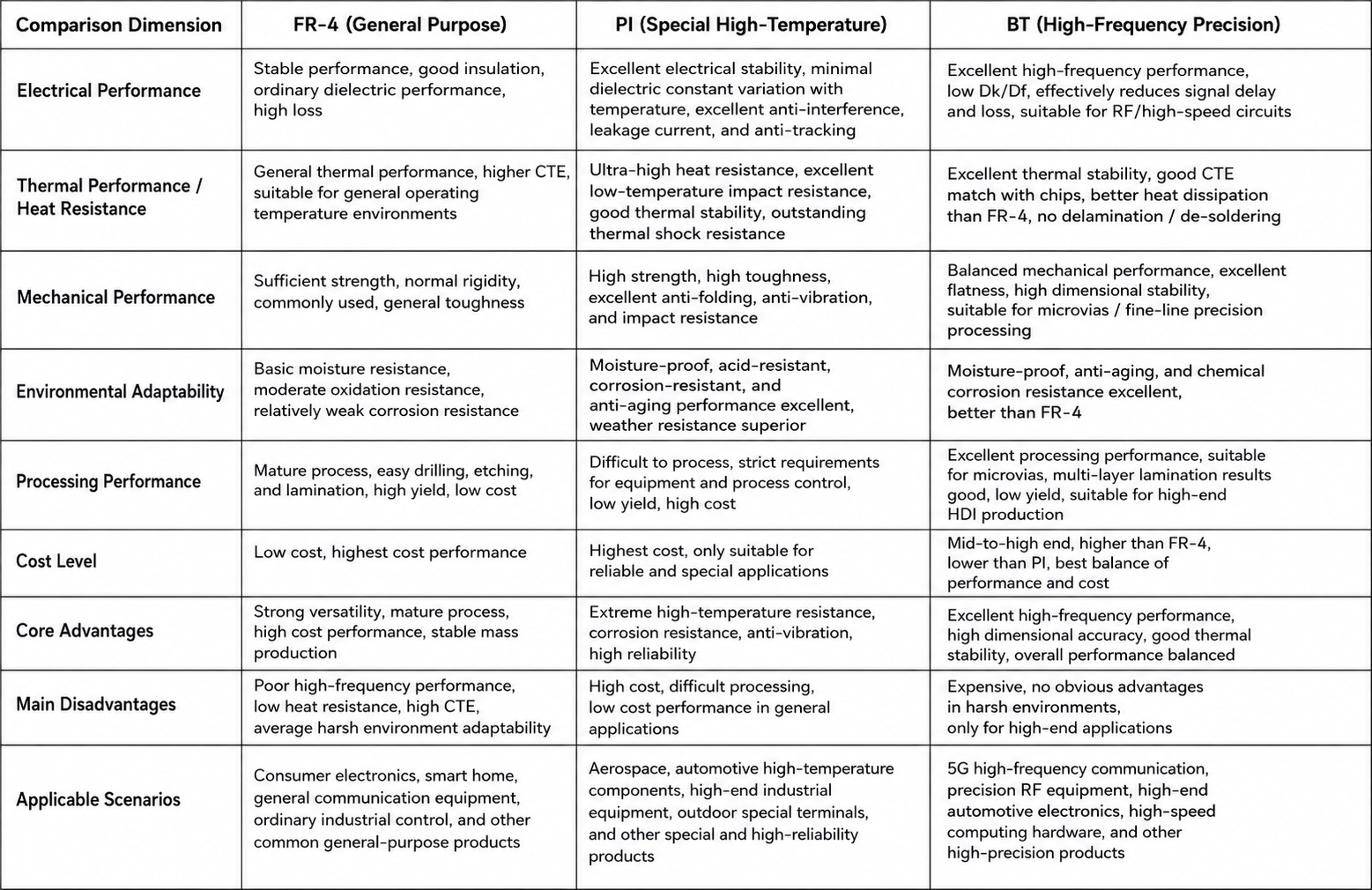
· Characteristics: Balanced electrical properties, mature processing technology, exceptionally high cost-effectiveness, and adequate insulation, mechanical strength, and dimensional stability for general requirements.
· Limitations: Moderate high-frequency performance and heat resistance.
· Applications: Standard smartphone sub-boards, tablet auxiliary boards, smart home control boards, general industrial control boards, wireless charging modules, etc.
2. PI (Polyimide): High-End Specialty Substrate
· Characteristics: Ultra-high temperature resistance, excellent toughness, moisture resistance, acid/alkali resistance, aging resistance, and strong vibration resistance.
· Limitations: High processing difficulty, high material and volume-production costs.
· Applications: Aerospace airborne boards, high-temperature drone circuit boards, automotive powertrain control boards, marine monitoring equipment, chemical explosion-proof equipment, high-end flexible wearable motherboards.
3. BT: Mid-to-High-End Precision Composite Substrate
· Characteristics: Low dielectric loss, good thermal stability, high dimensional accuracy, good processability, and balanced overall performance.
· Limitations: Higher cost than FR-4 but lower than PI.
· Applications: 5G flagship smartphone motherboards, millimeter-wave communication modules, high-end RF antennas, automotive autonomous driving perception modules, high-speed memory/compute hardware, precision medical electronics HDI boards.
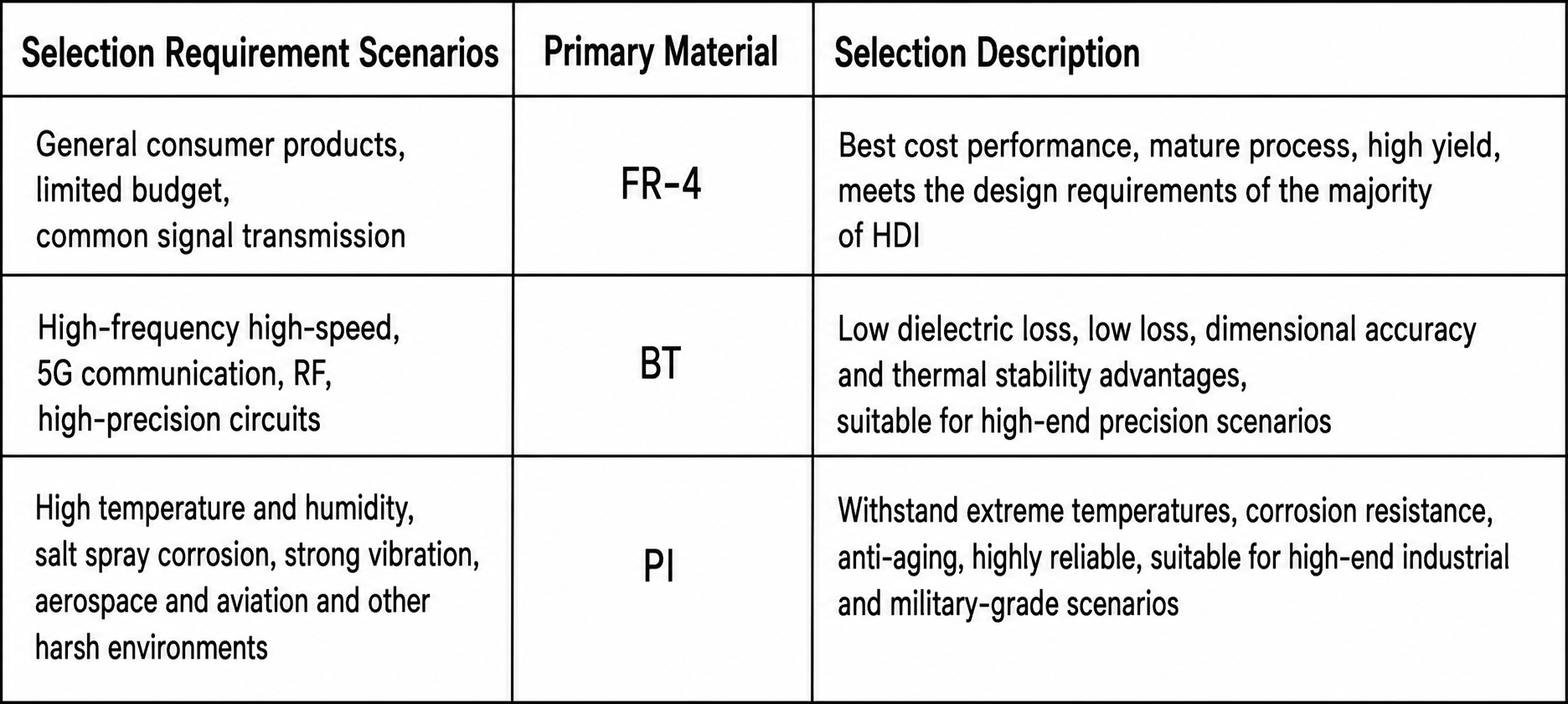
III. HDI Material Quick Selection Comparison Table (For Rapid Selection)

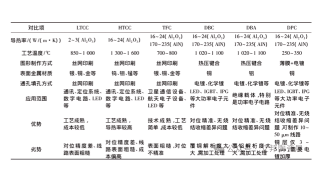
IV. HDI Material Detailed Parameter Comparison Table (Professional Benchmarking)

V. Overall Selection Summary
HDI board material selection need not blindly pursue the highest-end options. Instead, it should follow three core principles: scenario appropriateness, performance matching, and cost controllability, while leveraging proven cases for rapid deployment:
· Standard consumer applications, cost-sensitive, with no special high-frequency/high-temperature requirements (e.g., smart home, general digital accessories, low-end phone sub-boards) → Prioritize FR-4, balancing practicality and cost-effectiveness.
· 5G communication, RF precision, high-speed computing and other mid-to-high-end scenarios (e.g., flagship phone motherboards, autonomous driving modules, RF communication equipment) → Prefer BT substrates to ensure signal integrity, dimensional accuracy, and thermal stability.
· Aerospace, specialty industrial, outdoor extreme-condition high-reliability applications (e.g., airborne control boards, chemical monitoring equipment, high-temperature automotive components) → Must use PI substrates to ensure weather resistance and long-term service reliability.
All selection work must integrate substrate processability, volume-production stability, and project budgets for comprehensive evaluation, avoiding both over-engineering and under-specification, ultimately achieving the optimal balance among product quality, service reliability, and production cost.
trending news
Contact Us