



Sorry, no sales person is available right now to take your call. Pls leave a message and we will reply to you via email as soon as possible.
Conformal Coating for PCB Reliability: Material Selection, Process Control & Industrial Application Insights
2026-10-13
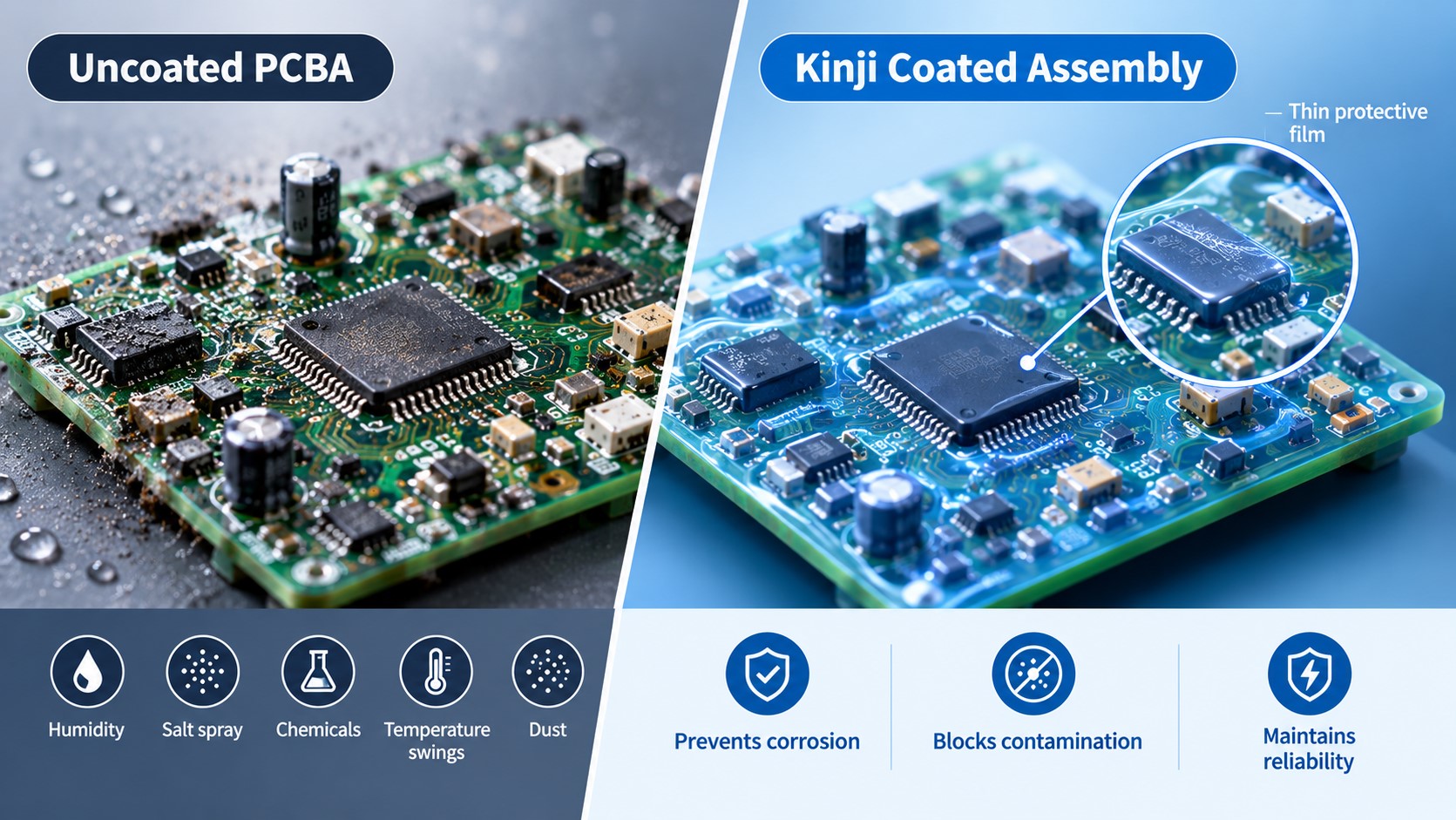
When your PCB assemblies operate outdoors, inside vehicles, or in industrial control cabinets, environmental stressors — humidity, salt spray, chemical vapors, rapid temperature swings and dust — are the top causes of premature field failure. Conformal coating is a proven reliability solution that forms a tailored protective barrier over your finished PCBA. At Kinji Group, we integrate conformal coating services into our PCB & PCBA workflow, helping customers select the proper coating formula, define coating zones, and execute controlled application & inspection to match your project’s lifecycle and budget.

What is Conformal Coating?
Conformal coating is a thin polymer film (typically 25–75 μm) applied onto assembled printed circuit boards. The material follows the uneven topography of components, solder joints and traces. Unlike bulky potting compounds, it adds minimal mass and thickness while maintaining electrical insulation. It acts as a breathable shield without locking out all internal vapor exchange.
Main Conformal Coating Types & Application Matching
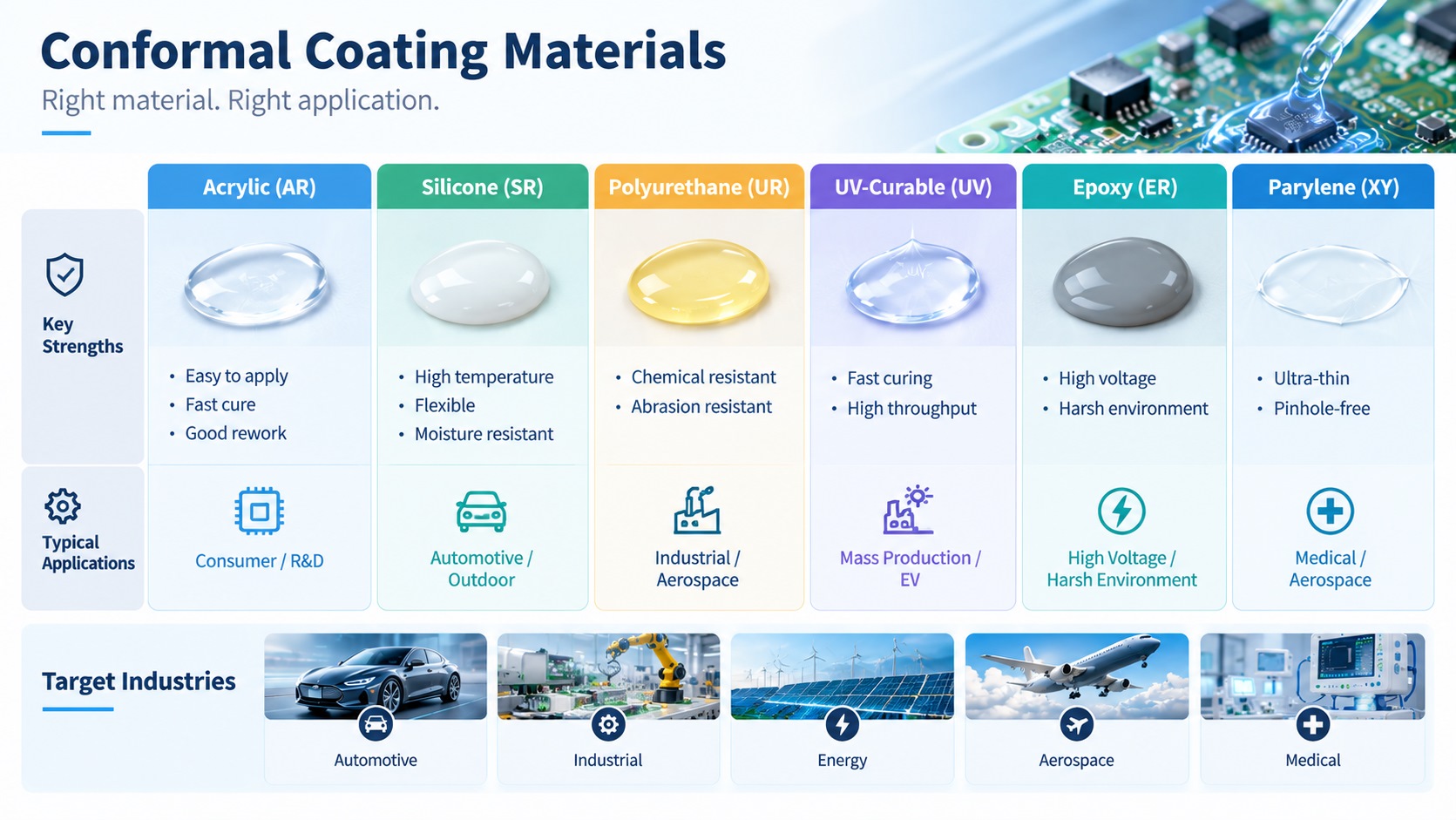
| Coating Grade | Core Strengths | Ideal Use Cases |
| Acrylic (AR) | Simple application, fast cure, easy stripping & rework | Consumer hardware, R&D prototypes, low-to-mid reliability projects |
| Silicone (SR) | Excellent thermal endurance & flexibility, strong moisture resistance | Automotive electronics, outdoor sensors, high-temperature industrial controls |
| Polyurethane (UR) | Outstanding chemical and abrasion resistance | Industrial automation, fuel-exposed equipment, long-lifecycle hardware |
| UV-Curable (UV) | Seconds-level curing, high throughput | Mass production EV boards, high-volume consumer electronics |
| Epoxy (ER) | Hard, dense moisture barrier, robust dielectric performance | High-voltage modules, semi-submerged and severe corrosive environments |
| Parylene (XY) | Pinhole-free ultra-thin vapor deposition coating | Medical electronics, aerospace sensors, MEMS and space-grade assemblies |
Material breakdown
· Acrylic (AR): Cost-effective, simple to rework, good basic moisture protection. Limitation: weak resistance against strong solvents. Great for prototype validation.
· Silicone (SR): Flexible thermal-stable coating, tolerates wide temperature cycling, widely adopted in automotive and outdoor industrial designs.
· Polyurethane (UR): Tough against oil, chemicals and physical abrasion, well-suited for factory floor and aerospace hardware.
· Epoxy (ER): High hardness and insulation. The tradeoff: extremely hard to remove, limited rework capability.
· Parylene (XY): Deposited under vacuum, delivers uniform coverage even in tiny gaps. Premium performance with higher processing cost and longer lead time.
Kinji’s Conformal Coating Application Processes
We offer three coating methods, selected based on board density, production batch size and keep-out zone requirements:
1. Manual Coating (Brush / Manual Spray) Best for prototype builds, small batches and rework tasks. Flexible for localized touch-ups, but coating consistency depends heavily on operator skill, not recommended for ultra-dense PCBAs.
2. Automated Spray & Dip Coating Programmed equipment delivers repeatable film thickness for medium and mass runs. Stable process control for standard boards, suitable for high-volume industrial and automotive orders.
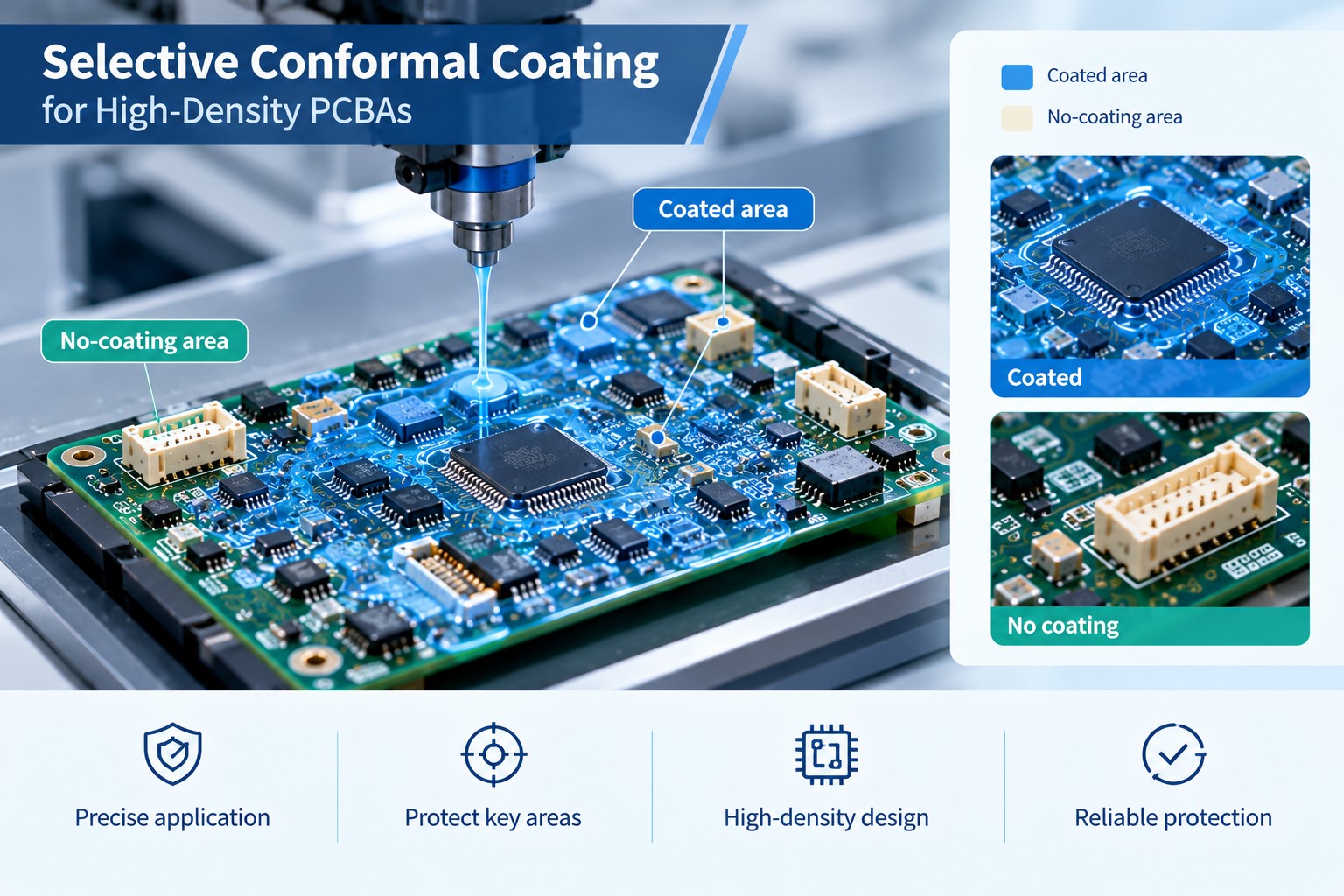
3. Selective Robotic Coating Our preferred option for high-density designs. The robotic system precisely applies coating only on designated regions, automatically skipping connectors, test pads, switches and heat-sensitive components. It eliminates masking labor and avoids functional interference on critical contact points.

Inspection, Rework & Quality Control (IPC-CC-830 aligned)
Quality verification is built into Kinji’s coating workflow. We use UV visual inspection and AOI scanning to check for bubbles, voids, pinholes and uneven film coverage, plus thickness measurement to stay within your specified tolerance. When defects appear, targeted rework safely removes coating in localized zones, preserving solder joints and nearby components, so boards can pass final reliability validation.
Key Selection Criteria with Kinji’s DFM Guidance
When specifying conformal coating, our engineering team reviews these items together with your design files:
✅ Operating environment: temperature range, humidity, salt spray or chemical exposure
✅ Electrical specs: dielectric strength, high voltage / high-frequency requirements
✅ Service & repair plan: whether rework or component replacement will be needed later
✅ Coating thickness and keep-out areas on PCB layout
✅ Curing method and production cycle time
✅ Budget and supply chain timeline
Common Conformal Coating Pitfalls & Mitigation
Many projects run into avoidable coating issues without early DFM review:
· Uneven coverage / bubbles: solved by controlled factory environment + automated selective coating
· Hidden voids missed by basic visual check: UV + AOI inspection as standard
· Over-coating blocking connectors or fine-pitch parts: define keep-out zones at DFM stage before production
· Wrong coating chemistry selected for operating conditions: Kinji engineers recommend materials according to your end-use environment
The Next Wave of Conformal Coating Technology
Material innovation continues to bring more eco-friendly, low-VOC coating chemistries. Digital dispensing and inkjet selective coating reduce waste and boost precision, while nanocoating formulations are opening new possibilities for miniaturized high-reliability electronics.
Wrap-Up
Conformal coating is not a one-size-fits-all add-on. The right material and application process will drastically cut field failure rates and extend your product’s service life. Kinji Group delivers end-to-end PCB & PCBA solutions including DFM review, precision conformal coating, full inspection and rework support for automotive, industrial, energy, aerospace and medical electronics. Talk with our engineering team to tailor a coating solution for your next project.
trending news
Contact Us