



Sorry, no sales person is available right now to take your call. Pls leave a message and we will reply to you via email as soon as possible.
8-Layer Hybrid Embedded Metal Base PCB | Kinji RO4350B Thermal Solution
2026-04-17
Why 5G RF Amplifiers Overheat (And How Kinji’s 8‑Layer Hybrid Embedded Metal Base PCB Fixes It)
Thermal management has become the #1 design bottleneck for high‑power electronics.
From 5G base stations to aerospace RF modules, engineers are fighting the same battle: how to pull heat away from high‑density chips fast enough, while
maintaining signal integrity and assembly yield.
Traditional FR‑4 boards simply don’t conduct heat well. Standard metal‑core PCBs often suffer from poor flatness, causing SMT defects and reliability issues. And exotic cooling solutions drive up cost and complexity.
But there’s a new benchmark.
Kinji (Qinji) – a specialist in advanced PCB manufacturing – has released an 8‑layer hybrid press‑fit locally embedded metal base PCB that combines the best of Rogers high‑frequency laminates, precision copper block embedding, and ultra‑tight flatness control.
Here’s why it’s changing the game for 5G RF power amplifiers and other high‑heat, high‑frequency applications.
The Hidden Cost of Heat in 5G RF Designs
Take a typical 5G AAU (Active Antenna Unit) RF power amplifier module. PA chips run hot – often exceeding 100°C junction temperature under full load. Excessive heat not only degrades output power and EVM (Error Vector Magnitude), but also shortens device lifetime.
Traditional PCB solutions fail in three ways:
Poor thermal conductivity – FR‑4 has a thermal conductivity of ~0.3 W/m·K, acting like a blanket over the chip.
Warpage & flatness issues – Metal‑base PCBs often have copper flatness >50μm, leading to poor die attach and SMT voids.
Signal loss – Standard materials can’t maintain low loss at Sub‑6GHz and mmWave frequencies.
Engineers are forced to compromise: either live with lower power, add expensive external heat sinks, or accept mediocre manufacturing yields.
Kinji’s Breakthrough: Embedded Metal Base + RO4350B Hybrid
Kinji’s solution takes a completely different approach – embedded copper block inside an 8‑layer hybrid stack‑up.
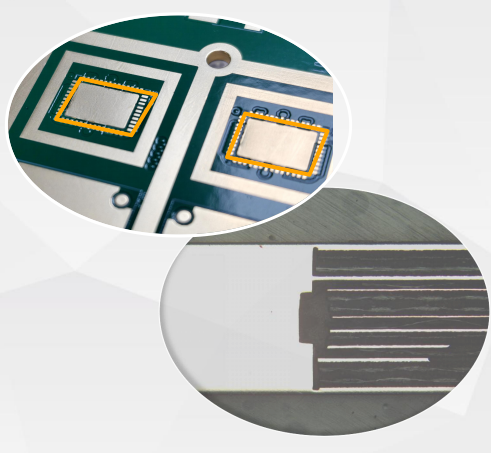
1. Extreme Thermal Path – Tens of Times Better than FR‑4
Instead of relying on thermal vias or separate heat spreaders, the PCB is designed with a locally embedded copper base that directly contacts the bottom of the PA chip (or its exposed pad). This creates a vertical, ultra‑low‑resistance heat conduction path.
- Thermal conductivity is tens of times higher than standard FR‑4.
- In real 5G AAU tests, PA junction temperature dropped by 18°C – enough to eliminate thermal throttling even in 40°C ambient environments.
2. RO4350B – High‑Frequency, Low‑Loss Performance
The 8‑layer structure uses Rogers RO4350B as the key high‑frequency laminate. With a stable dielectric constant (DK=3.48±0.05) and ultra‑low dissipation factor (tanδ=0.0037@10GHz), it guarantees:
- Low signal loss for clean EVM
- Consistent impedance across temperature
- Excellent compatibility with FR‑4 for hybrid lamination
3. ≤15μm Copper Flatness – A Game Changer for SMT Yield
Flatness is often overlooked, yet it directly impacts assembly reliability. Many metal‑base PCBs have copper flatness exceeding 50μm, causing:
- Poor thermal interface contact
- Solder voids and tombstoning
- Rework and field failures
Kinji holds copper base flatness to ≤15μm – verified by precision measurement. The result? In a mass‑production 5G AAU project, SMT yield jumped from 92% to 99.8%, and rework nearly disappeared.
4. Precision Embedding: Copper Blocks as Small as 5×5×0.5mm
For designs requiring localized hotspot cooling or tight space constraints, Kinji can embed copper blocks down to 5×5×0.5mm – enabling compact, high‑density layouts without sacrificing thermal performance.
Proven in the Field: 5G AAU Mass Production
The numbers below come from an actual deployment with a leading telecom infrastructure manufacturer using Kinji’s 8‑layer hybrid embedded metal base PCB in their 5G AAU multi‑channel RF PA module.
| Metric | Before (Traditional FR‑4 + external heat sink) | After (Kinji 8‑layer hybrid) |
|---|---|---|
| PA junction temperature | Reference | ↓18°C |
| Full‑power operation @40°C | Derating required | No derating |
| Linear output power gain | Baseline | +1.2dB |
| SMT first‑pass yield | 92% | 99.8% |
| 40°C continuous failure rate | 3.2% | <0.1% |
The solution passed temperature cycling, humidity, and vibration tests – and has since shipped millions of units in volume production.
Beyond 5G: Where Else This PCB Excels?
While the case study focuses on 5G RF PAs, the same technology applies to:
- High‑power microwave and radar modules – where both thermal dissipation and low loss are critical.
- Aerospace & defense electronics – demanding extreme reliability and flatness.
- High‑density power converters – embedding copper blocks under MOSFETs or IGBTs.
- Optical modules & LiDAR – tight thermal control for laser diodes.
Any application that suffers from hotspot‑driven performance limits and high‑frequency signal integrity requirements is a candidate.
Why Choose Kinji for Your Next High‑Power PCB Project?
Kinji isn’t just a prototype house. The company has built a mature manufacturing system around hybrid, embedded metal base technologies:
- Sample lead time: 10+ days – fast turnaround for design validation.
- Mass production: 15+ days – predictable, scalable.
- Engineering support – from material selection to flatness optimization.
- Proven reliability – millions of units in field deployment.
And unlike generic PCB suppliers, Kinji specializes in solving the “triple challenge” of high power, high frequency, and high flatness – a combination that few manufacturers can deliver consistently.
Final Takeaway: Stop Compromising on Thermal & Signal Performance
The days of choosing between low loss and good heat dissipation are over. Kinji’s 8‑layer hybrid press‑fit locally embedded metal base PCB (RO4350B + embedded copper) delivers:
- ✔ Tens of times better heat conduction than FR‑4
- ✔ ≤15μm copper flatness for best‑in‑class SMT yield
- ✔ Proven 18°C junction temperature drop in 5G AAU
- ✔ Scalable from prototype to million‑unit production
If you’re designing a 5G RF power amplifier, a high‑power radar, or any module where heat kills performance – it’s time to talk to Kinji.
👉 Contact Kinji today – get your sample in as few as 10 days and see the difference precision engineering makes.
Kinji – Ultimate Heat Dissipation, Precision Smart Manufacturing
trending news
Contact Us