



Sorry, no sales person is available right now to take your call. Pls leave a message and we will reply to you via email as soon as possible.
A Complete Guide to High-Density Interconnect (HDI) PCBs: From Build-Up Structures to Use Cases
2026-11-04
A high-density interconnect (HDI) board is a high-end PCB that achieves dense interlayer connections through smaller microvias, finer line width/spacing, and higher routing density.
Conventional multilayer PCBs typically use mechanical drilling to form through-holes that pass through the entire board:

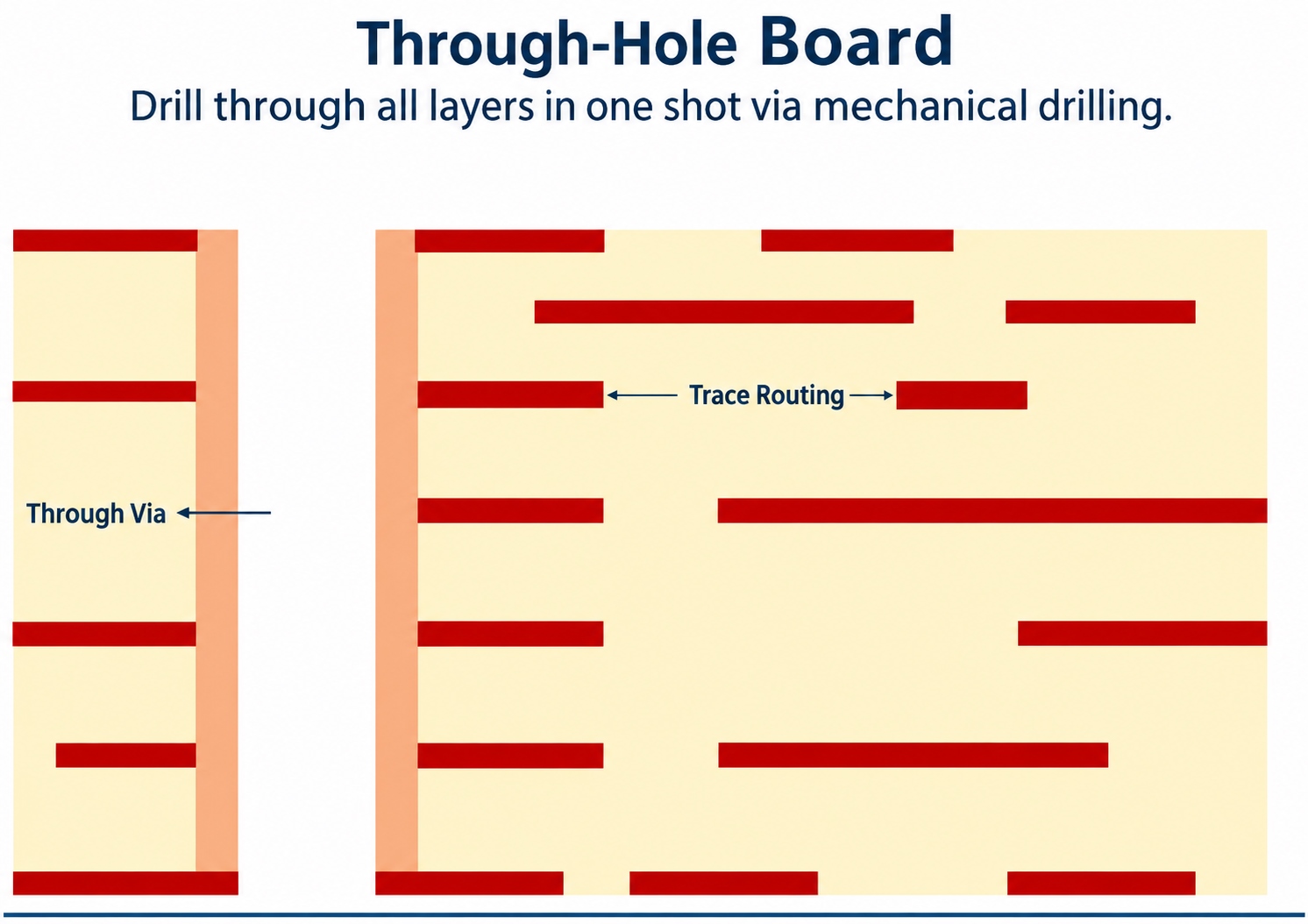
These through-holes consume area on every layer, limiting further gains in routing density.
HDI boards, by contrast, add build-up layers sequentially on both sides of a core board and mainly use laser drilling to form microvias and buried vias for interlayer connections:

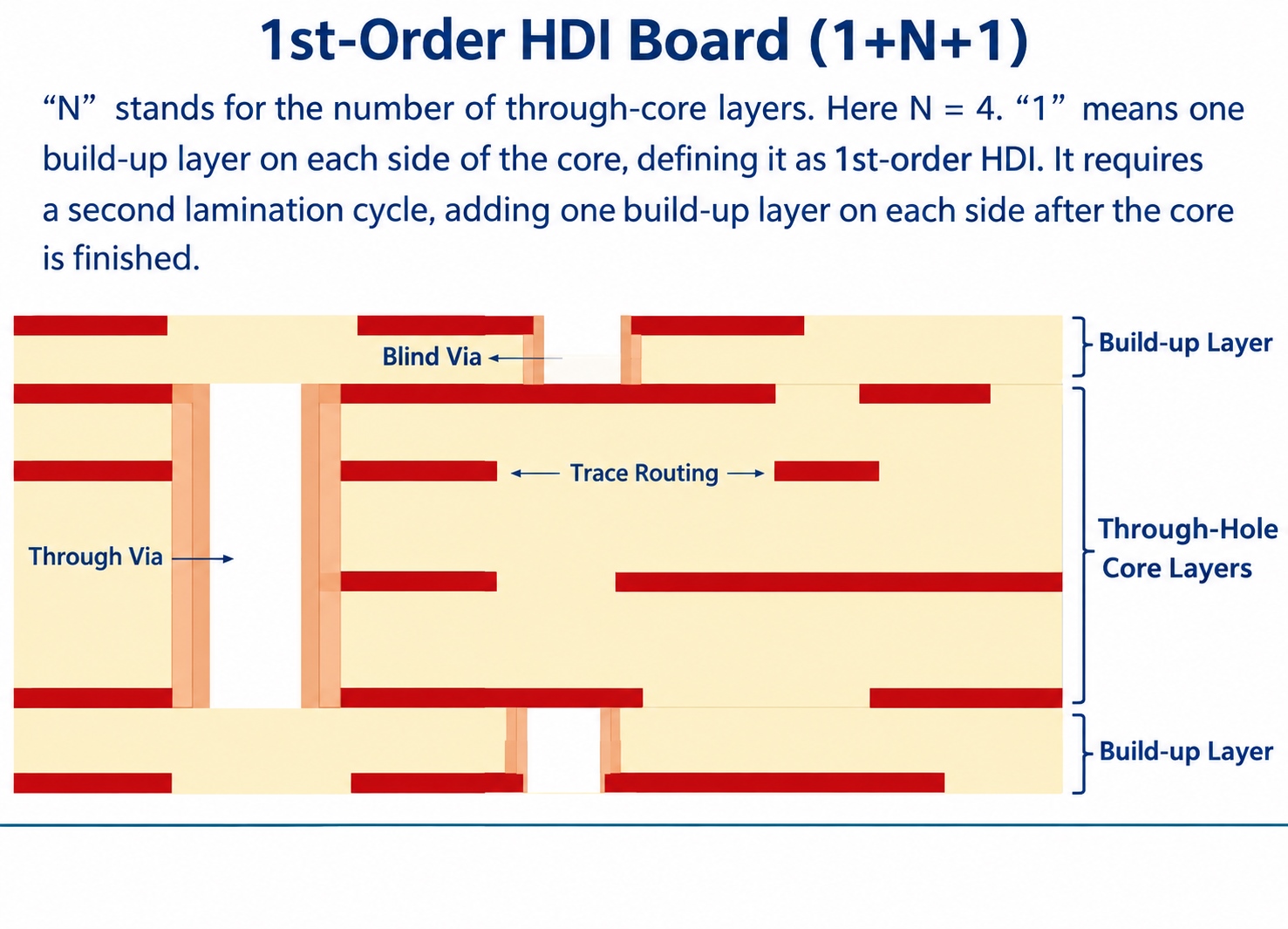
These microvias are typically smaller than 0.15 mm, commonly around 50–150 µm—markedly smaller than standard mechanical through-holes.
HDI boards are classified by the number of build-up layers:
· One build-up layer per side: 1st-order HDI, written as 1+N+1
· Two build-up layers per side: 2nd-order HDI, written as 2+N+2
· Three build-up layers per side: 3rd-order HDI, written as 3+N+3
And so on.
Here, N denotes the number of core layers, not the total PCB layer count.

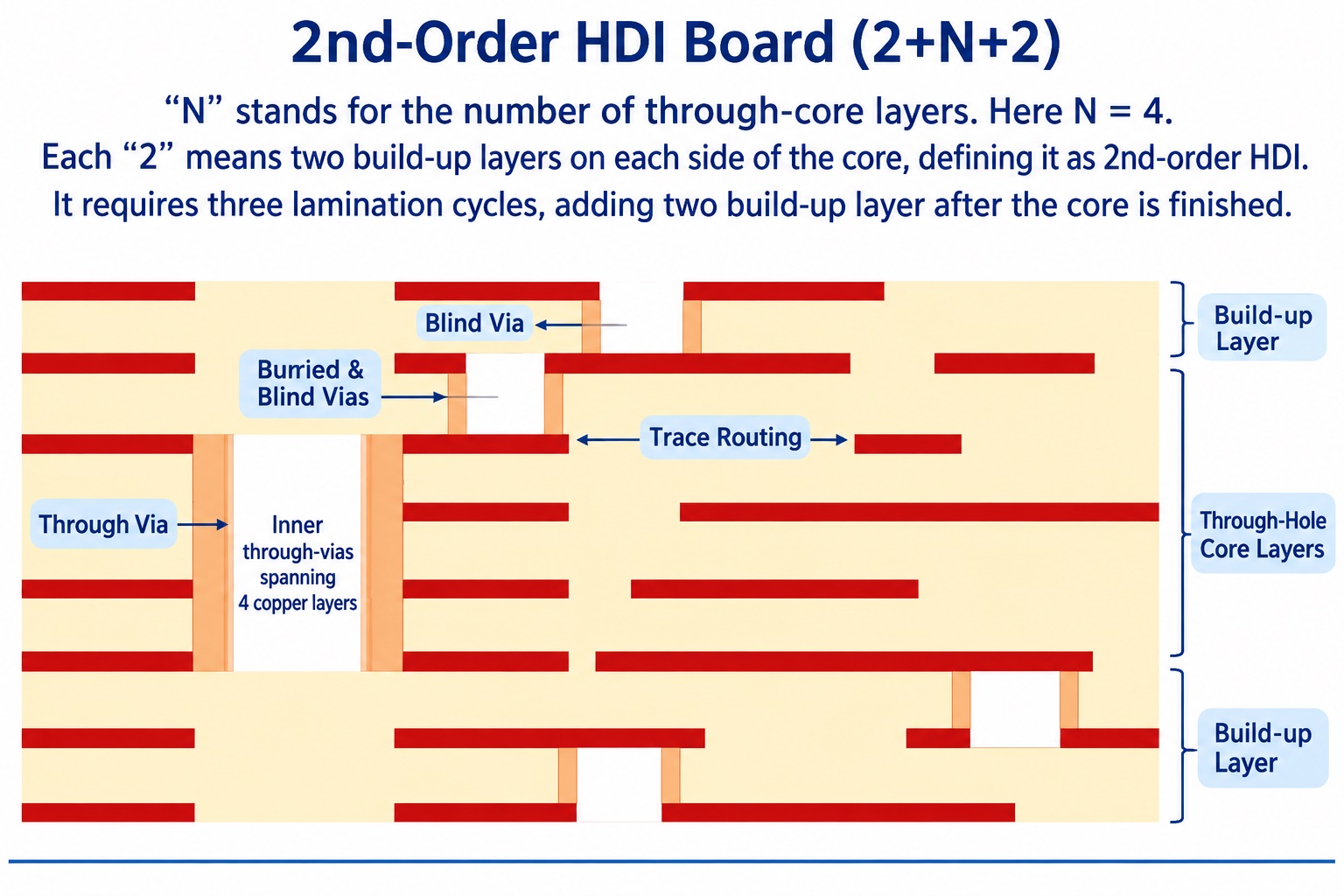
There is also any-layer HDI. Using an any-layer interconnect structure, it typically no longer relies on mechanical through-holes passing through the entire board; instead, layers are interconnected as needed via microvias, offering the highest routing freedom:

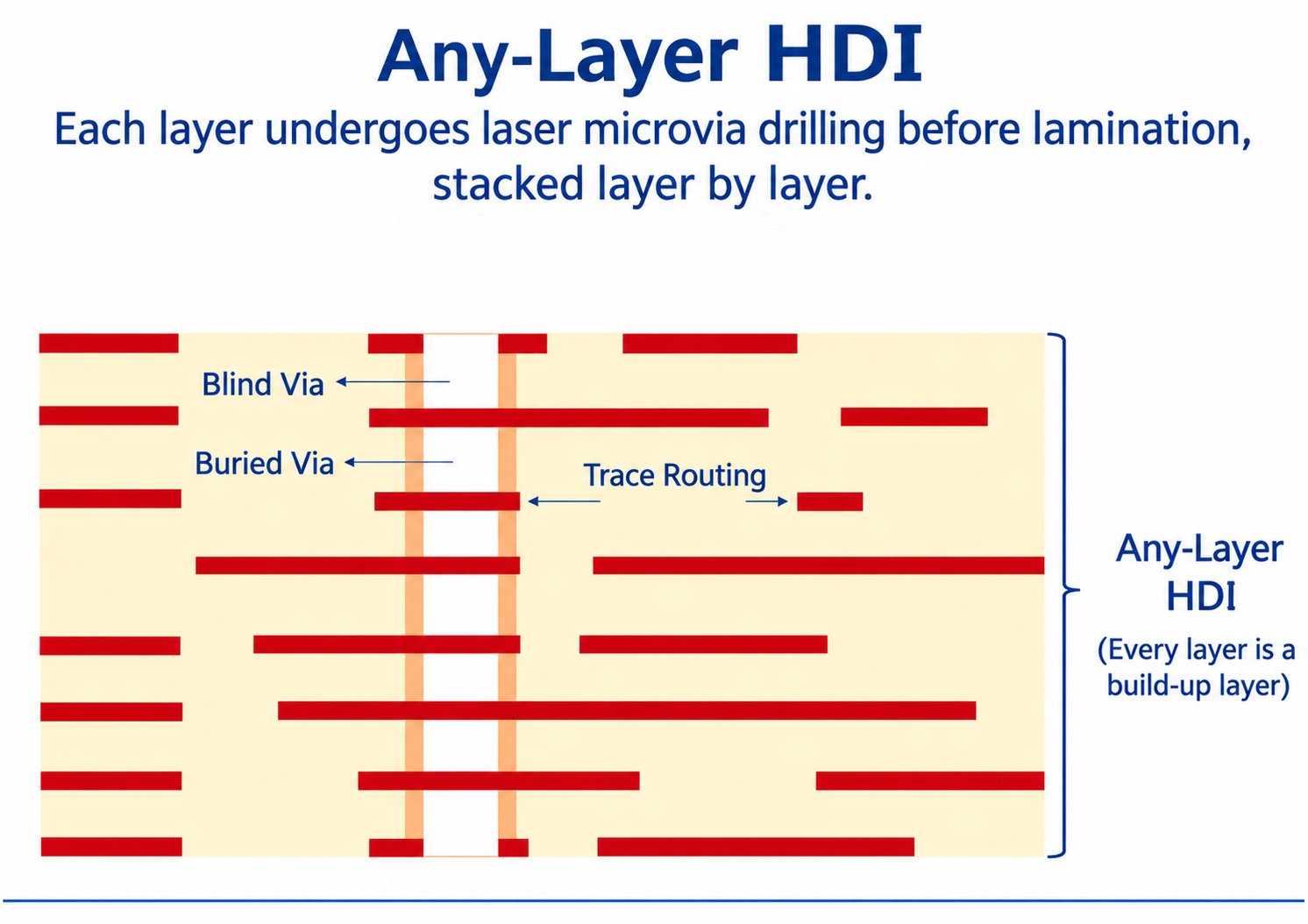
Conventional PCBs mostly use mechanical drilling, and through-holes are usually larger. HDI boards use laser drilling to produce smaller blind and buried vias and achieve finer line width/spacing, resulting in higher routing density. Note that HDI boards may still retain mechanical through-holes for core-layer connections, connector holes, and tooling holes—not every hole is a laser microvia.
It is precisely because of smaller microvias, denser routing, and more flexible interlayer connections that these PCBs are called high-density interconnect boards, or HDI boards.
Where Are HDI Boards Used? These Applications Depend on HDI
HDI is not limited to smartphones. Whenever a product demands a small form factor, multiple chips, and dense routing, an HDI solution is usually considered.
Smartphones & Foldable Phones
The largest HDI market. Flagship phones typically use 2nd- or 3rd-order HDI, while foldable flagship mainboards generally adopt any-layer HDI. Fitting RF, multi-camera interfaces, and power management chips onto a tiny mainboard makes HDI microvias key to slim, lightweight designs.
Wearables: Smartwatches, TWS Earbuds
Internal space in these products is extremely tight. TWS earbud mainboards are mostly 1st-order HDI, while smartwatch mainboards commonly use 2nd-order HDI, integrating Bluetooth, sensors, and battery management on a very small PCB.
AI Edge Computing Modules
Many embedded AI boxes and miniature compute cards now use 2nd- or 3rd-order HDI. Dense microvias shorten trace length, reduce high-speed signal attenuation, and ensure stable high-speed communication between chips.
Smart Automotive Electronics
Automotive cameras, millimeter-wave radar, and domain controller boards extensively use automotive-grade HDI. Beyond high density, these require extreme temperature resistance, humidity resistance, and long-term reliability—ordinary consumer HDI cannot directly replace them.
Portable Medical Devices
Endoscope probes, handheld analyzers, and compact vital-sign monitoring modules use medical-grade HDI. Devices must be small while maintaining low-interference signal transmission for stable measurement data.
Industrial Test & High-End IoT Sensors
Portable oscilloscope acquisition boards and multi-channel sensor modules rely on HDI to shrink board size and enable multi-channel signal acquisition.
Tip: Selection varies greatly by application. Consumer, automotive, and medical HDI differ significantly in materials, reliability testing, and process control standards, so product specifications should be clarified upfront.
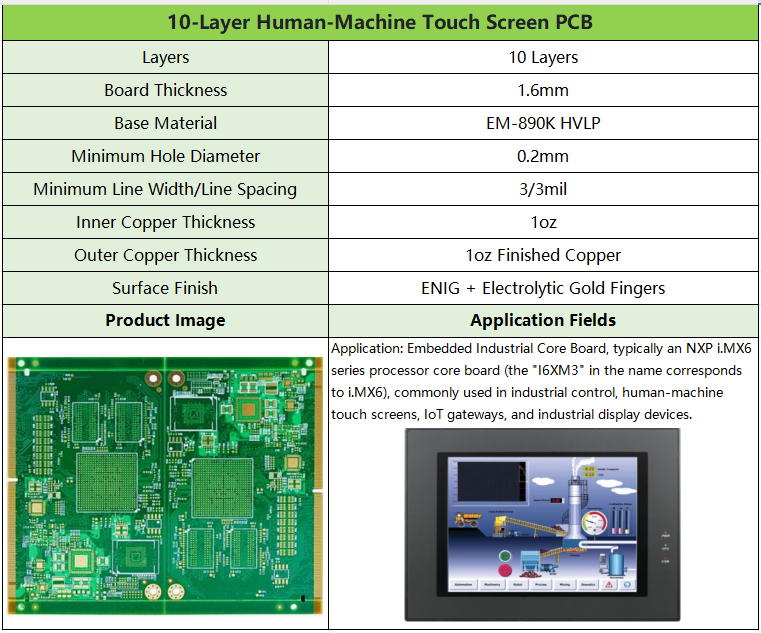
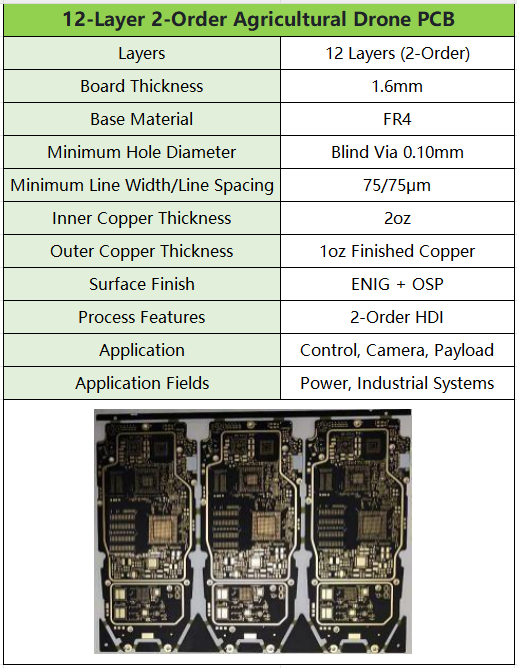
KINJI GROUP: Selected HDI Product Cases
trending news
Contact Us