



Sorry, no sales person is available right now to take your call. Pls leave a message and we will reply to you via email as soon as possible.
Industrial Robot Small-Batch PCB Production: Choosing the Right Process Ensures Stability and Reliability
2026-10-09
Industrial robots operate long-term in environments with high-frequency vibration, wide-temperature cycling, and strong electromagnetic interference, so the reliability requirements for their main control boards and servo drive boards are far higher than those for consumer electronics PCBs. The robotics industry generally features small batches, multiple varieties, and fragmented orders, with frequent line changes and high trial-and-error costs, making it difficult to spread risk through large-volume production. Therefore, the core approach is to use deterministic full-chain process rules to hedge against the production uncertainty brought by fragmented orders. Drawing on Kinji PCB's experience in small-batch PCB intelligent manufacturing, closed-loop control is implemented from substrate selection, process control, assembly and soldering, to testing and verification, achieving right-first-time production and batch stability.


I. Substrate Selection: Building a Highly Reliable Physical Foundation
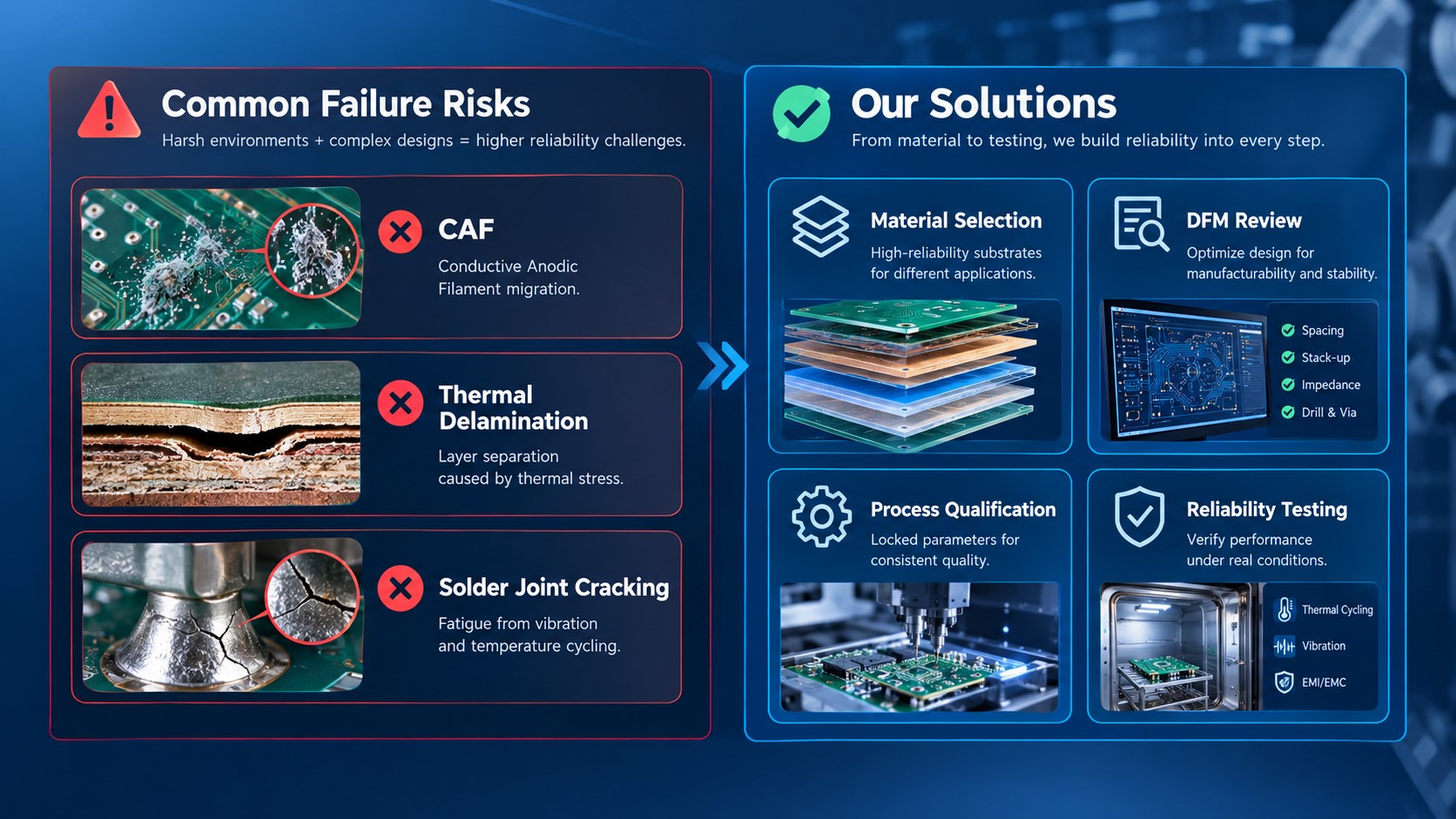
Early failures of industrial robot PCBs mostly stem from insufficient heat resistance, thermal expansion mismatch, and CAF (conductive anodic filament) migration. Therefore, materials must be precisely selected according to module functions:
Conventional multilayer control boards: Use FR-4 substrates with Tg >= 170C, low CTE, and high CAF resistance to withstand thermal stress and reduce deformation, impedance drift, and microcracks in traces.
High-power heat dissipation modules: For servo and IGBT power boards, IMS aluminum substrates/copper substrates are preferred; for ultra-high-power and high-voltage scenarios, ceramic substrates can be used to achieve rapid heat conduction.
High-frequency signal modules: For robot vision and real-time bus communication scenarios, Rogers or TMM series high-frequency materials are used to ensure low signal loss and stable impedance.
Case 1 | Heat Resistance Upgrade of a Six-Axis Collaborative Robot Joint Drive Board
The customer's first-generation solution used ordinary FR-4. During full-load testing, heat generated by the IGBT caused local Tg failure of the board, resulting in microcracks and impedance drift. After switching to a high-thermal-conductivity aluminum substrate and matching high-temperature processes, device junction temperature dropped by about 18C, and 500 hours of continuous aging testing showed no failures, solving the early failure problem caused by thermal stress.
II. Process Control: Modular Parameter Locking to Reduce Small-Batch Line-Change Fluctuations
One of the main risks in small-batch production is parameter drift caused by frequent line changes. To address this, variables must be locked through upfront engineering review and fixed process parameters.
DFM upfront review: Before production, conduct manufacturability analysis through CAM, focusing on line width and spacing, drilling, stack-up symmetry, impedance, and copper-to-hole safety distances, to identify CAF and alignment deviation risks in advance. Kinji PCB has established a dedicated review checklist for industrial PCBs, intercepting most hidden risks at the engineering stage.
Core process parameter fixation: High-Tg materials use dedicated lamination heating curves to prevent uneven resin flow and residual internal stress; drilling parameters are independently configured according to substrate material to ensure hole-wall quality and suppress CAF failure; blind and buried via boards introduce inner-layer scaling compensation and optical alignment to improve interlayer precision.
Preferred surface treatment: For vibration and high-temperature conditions, ENIG or ENEPIG is preferred, offering good pad flatness and strong oxidation resistance, ensuring long-term soldering reliability.
Case 2 | Yield Improvement of an AGV Main Control Board
For a logistics robot's first batch of 50 main control boards, yield was only 72% due to blind and buried via alignment deviation. Through modular packaging of process parameters, automatic optical alignment, and inner-layer scaling compensation, line-change debugging time was shortened by 40%, and subsequent batch yield stabilized above 98.5%.

III. Assembly Soldering and Component Adaptation: Controlling Thermal Stress and Avoiding Assembly Failure
A qualified bare board is only the foundation. Robot boards often mix multiple substrate types, with large differences in heat capacity and dense power devices, so customized SMT solutions are required.
Customized reflow profiles: Measure actual furnace temperature profiles according to panel structure and substrate type to balance soldering quality and avoid substrate delamination and cold solder joints caused by thermal shock; support SPI and AOI to control solder joint quality.
Stress optimization for high-frequency power devices: For GaN and other high-frequency power devices, high-density copper-filled thermal vias can be placed under power pads; under high-vibration conditions, Underfill is added to relieve mechanical stress caused by thermal cycling and suppress solder joint fatigue cracking.
Case 3 | Iteration of a GaN Power Module for a Lightweight Robotic Arm
A special robotic arm used GaN devices for weight reduction. Initial prototyping had high-frequency noise and local overheating. By optimizing the stack-up, using Rogers material for key signal layers, and adding copper-filled thermal vias in power areas, the module volume was reduced by 30% after modification, full-load temperature rise was controlled within a safe range, and vibration and aging tests stably met standards.
IV. Test Verification: Data Closed Loop as the Backstop for Reliability
Small-batch production usually lacks redundant spare parts, so hidden defects must be intercepted through testing, and a traceable verification system must be established.
Flying probe electrical performance testing: No mold opening is required, making it suitable for multiple varieties and small batches. It quickly detects open circuits, short circuits, insulation, and impedance anomalies, balancing efficiency and detection coverage.
Environmental reliability sampling verification: Sample boards are drawn proportionally for thermal shock, temperature-humidity bias THB, and mechanical vibration testing to simulate extreme robot operating conditions and verify substrate peel strength, trace, and pad durability.
Case 4 | Weather Resistance Verification for an Outdoor Inspection Robot
PCBs for a substation inspection robot need to withstand wide temperature changes from -40C to +85C and strong electromagnetic environments. In addition to conventional AOI and flying probe testing, 100 thermal shock sampling tests were added, revealing hidden risks of insufficient solder mask curing in advance. After correcting process parameters, the batch was delivered. The products from this batch have been online for two years without related repairs.
V. Core Adaptability Advantages of the Small-Batch PCB Production Model
In response to the industry characteristics of fast R&D iteration, many model types, and frequent pre-mass-production trial production in industrial robotics, standardized small-batch PCB production has strong scenario adaptability. Compared with traditional large-volume production models, it requires no high mold-opening costs and has no minimum order quantity limit, effectively reducing trial-and-error costs in new product development and avoiding scrap risks from large-volume production. At the same time, the flexible production model can support simultaneous production of multiple categories and multiple process materials, adapting to the parallel iteration needs of multiple robot product models. Relying on upfront DFM review, independent parameter control, and short-chain delivery advantages, it can quickly respond to redesign iterations, problem tracing, and on-site spare parts replenishment needs, better matching the production needs across the entire lifecycle of industrial robot R&D verification, small-batch pilot production, and later operation and maintenance.
Conclusion
The reliable manufacturing of industrial robot small-batch PCBs centers on upfront design review, process parameter fixation, and rigorous reliability verification. Unlike the general production logic of consumer electronics, industrial-grade PCBs require full-chain process matching for vibration, wide temperature, high heat, and strong interference conditions. Relying on its engineering capabilities for small-batch industrial PCBs, Kinji PCB helps robot customers achieve right-first-time, batch-stable, and replicable implementation of small- and medium-batch PCBs through upfront DFM risk interception, modular process control, and a closed loop of reliability testing.
trending news
Contact Us