


Sorry, no sales person is available right now to take your call. Pls leave a message and we will reply to you via email as soon as possible.
The Role of Flex PCB in Automotive Electronics
2026-08-14
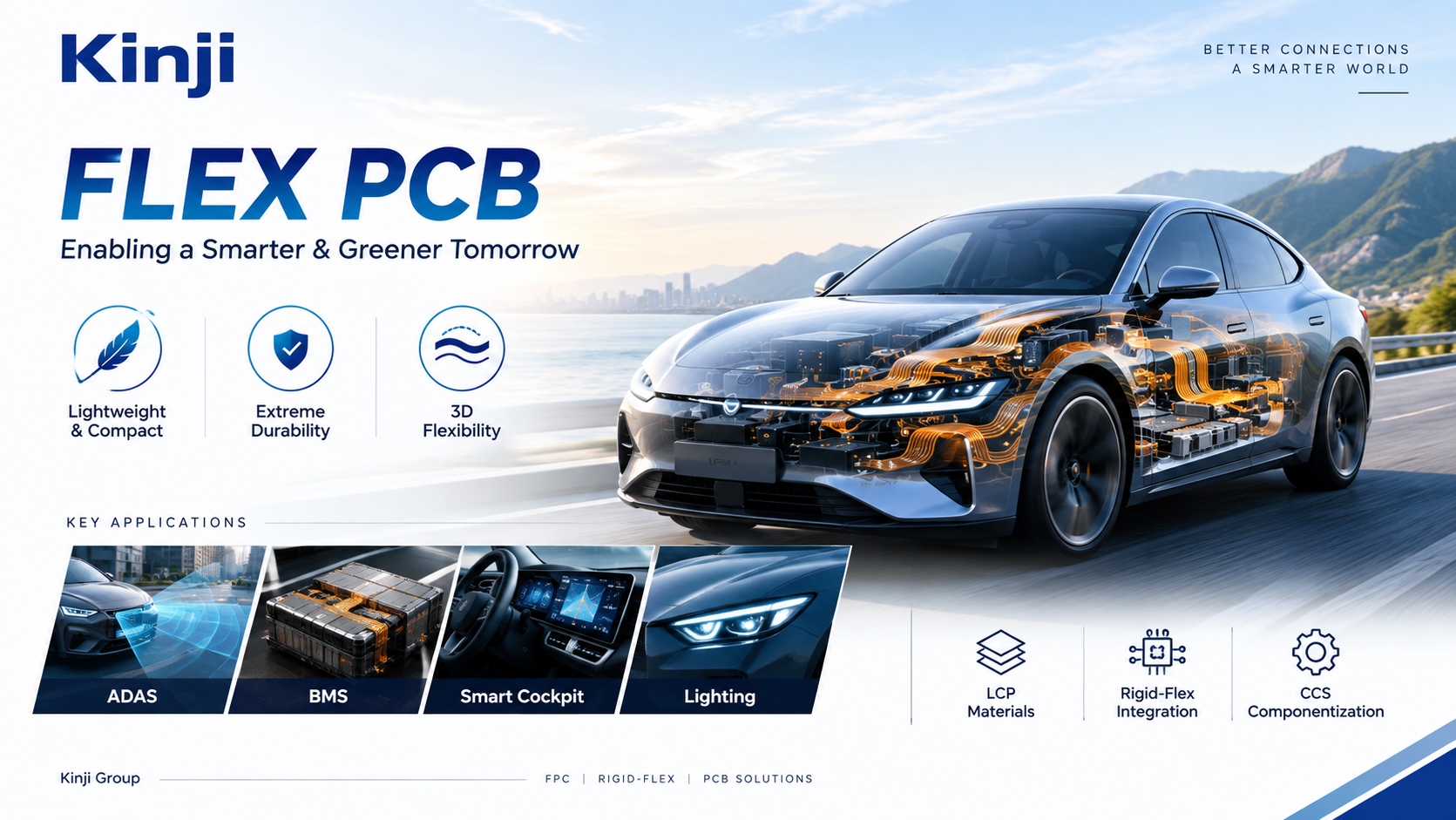
Flexible printed circuit boards (Flex PCBs) have become an indispensable component in modern automotive electronics. As the automotive industry rapidly advances toward electrification, intelligence, and lightweighting, Flex PCBs—with their unique physical properties and electrical performance—are progressively replacing traditional wiring harnesses and rigid circuit boards. They are playing an increasingly vital role in critical areas such as Advanced Driver Assistance Systems (ADAS), Battery Management Systems (BMS), infotainment systems, and lighting systems.

What is Flex PCB?
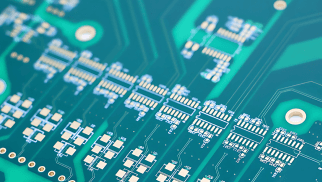
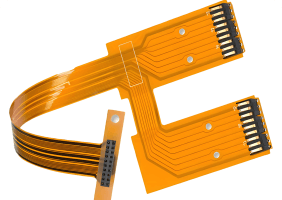
Flex PCBs are circuit boards made from flexible substrate materials such as polyimide or polyester films, enabling bending and twisting capabilities. Compared to conventional rigid PCBs, they offer the following distinctive advantages:
· Space Savings and Weight Reduction: They can be folded or bent along vehicle body structures, significantly reducing wiring harness volume and weight. In new energy vehicles, using FPC to replace traditional wiring harnesses can reduce battery pack weight by approximately 3 kilograms while eliminating dozens of wire bundles.
· High Reliability in Harsh Environments: Manufactured with high-temperature-resistant materials like polyimide (withstanding up to 250°C), they exhibit excellent resistance to vibration, moisture, and chemical corrosion, making them suitable for demanding automotive operating conditions.
· 3D Design Freedom: They support three-dimensional routing and can conform to irregular spatial layouts, offering flexible solutions for the integration of complex components.
Key Applications in Automotive Electronics
1. Advanced Driver Assistance Systems (ADAS)
ADAS technology relies heavily on real-time sensor data processing and transmission. Flex PCBs are widely used in camera, radar, and LiDAR modules. Their high-speed signal transmission capabilities and electromagnetic interference (EMI) shielding characteristics ensure the accuracy and stability of perception systems.
2. Battery Management Systems (BMS) in New Energy Vehicles
The power battery is the core of new energy vehicles, and the BMS serves as its "brain." FPCs play a critical role in BMS by acquiring cell voltage and temperature signals. Compared to traditional copper wire harnesses, FPCs offer the following significant advantages: high integration—combining signal acquisition, temperature monitoring, and intelligent fuse functions into a single unit; enhanced safety—with built-in fuse designs that automatically blow copper traces during short circuits to prevent thermal runaway; and support for automated assembly—suitable for mass production, improving efficiency and consistency.
3. Smart Cockpit and Infotainment Systems
Modern vehicle cockpits are evolving toward multi-screen and high-definition configurations. FPCs are used to connect instrument clusters, center consoles, and passenger as well as rear-seat entertainment screens. Addressing the pivoting and sliding mechanisms of in-vehicle multi-screen setups, highly flexible FPCs must withstand over 100,000 dynamic bending cycles. Meanwhile, to support 4K/8K high-definition displays and Gigabit Ethernet transmission, FPCs require impedance-controlled designs and low-loss substrates to ensure signal integrity. In Head-Up Display (HUD) modules, innovative FPC structural designs have effectively reduced module size, improving cockpit space utilization.
4. Lighting Systems
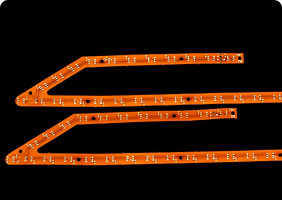
Adaptive LED headlights, ambient interior lighting, and other lighting systems extensively employ FPCs. Their thin and lightweight properties facilitate installation within narrow lamp cavities while supporting the current-carrying capacity required to drive LEDs.


Trends and Innovations in Automotive Flex PCBs
Material Upgrades: High-Frequency and High-Speed Performance
With the proliferation of 5G-V2X and millimeter-wave radar (77/79 GHz), the dielectric loss of traditional PI substrates at high frequencies can no longer meet requirements. LCP (Liquid Crystal Polymer) and other emerging high-frequency flexible materials, known for their stable low-loss characteristics across full frequency bands, are becoming the "gold standard" for in-vehicle high-frequency interconnections.
Process Innovation: Rigid-Flex Integration and High-Precision Manufacturing
Rigid-flex boards combine the structural support of rigid boards with the bendability of flexible boards, reducing connector counts, enhancing reliability, and further simplifying assembly processes. Additionally, FPC manufacturing is advancing toward higher layer counts (e.g., 16 layers), finer trace/space dimensions (35μm/35μm), and smaller via holes (0.025mm laser drilling) to meet high-density integration requirements.
Integration and Lightweighting
Under the trends of CTP (Cell-to-Pack) and CTC (Cell-to-Chassis) technologies, FPCs are evolving from single-function signal acquisition lines toward integrated CCS (Cell Connection System) component solutions. Combined with plastic structural parts and copper-aluminum busbars, they form modular electrical connection and signal detection assemblies.
Conclusion
In summary, Flex PCBs—with their advantages in space savings, lightweighting, high reliability, and design flexibility—have become a cornerstone in advancing automotive electronics technology. As vehicle intelligence and electrification deepen, the demand for high-performance, high-reliability FPCs will continue to rise.
In this field, Kinji Group, with 29 years of PCB manufacturing experience, demonstrates formidable technical strength. The company possesses design and manufacturing capabilities for 1- to 16-layer FPCs and rigid-flex boards, with process capabilities including minimum trace/space of 0.035mm/0.035mm and minimum laser-drilled via of 0.025mm. Strictly adhering to automotive industry quality management systems such as IATF16949, its products are widely used in automotive electronics (including brake lamp FPCs, new energy lithium battery FPCs, and more), industrial control, and communication RF sectors. By implementing fully automated production equipment and rigorous layer-by-layer inspection processes, Kinji Group ensures high yield rates, delivering one-stop high-reliability solutions—from PCB manufacturing and SMT assembly to component sourcing—for global customers.
trending news
Contact Us